


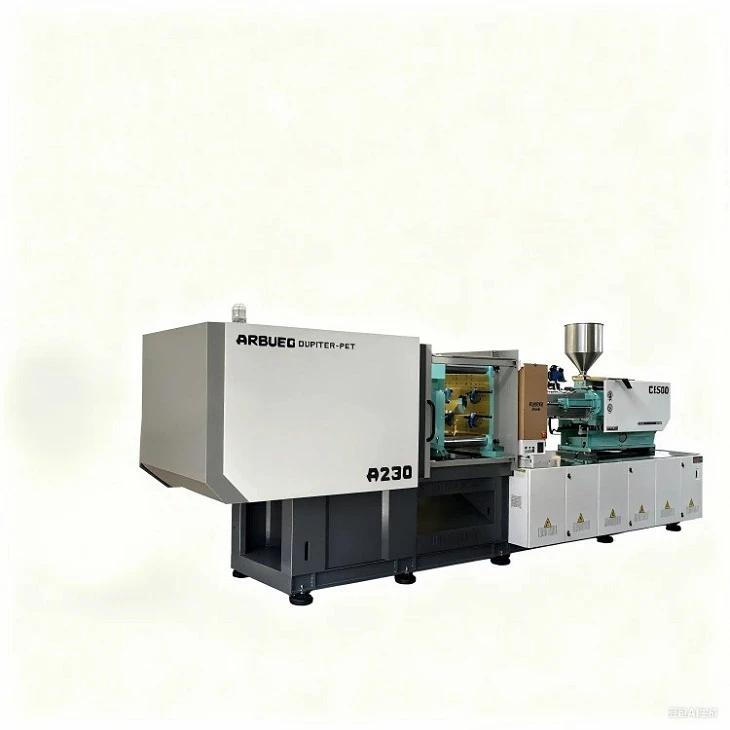
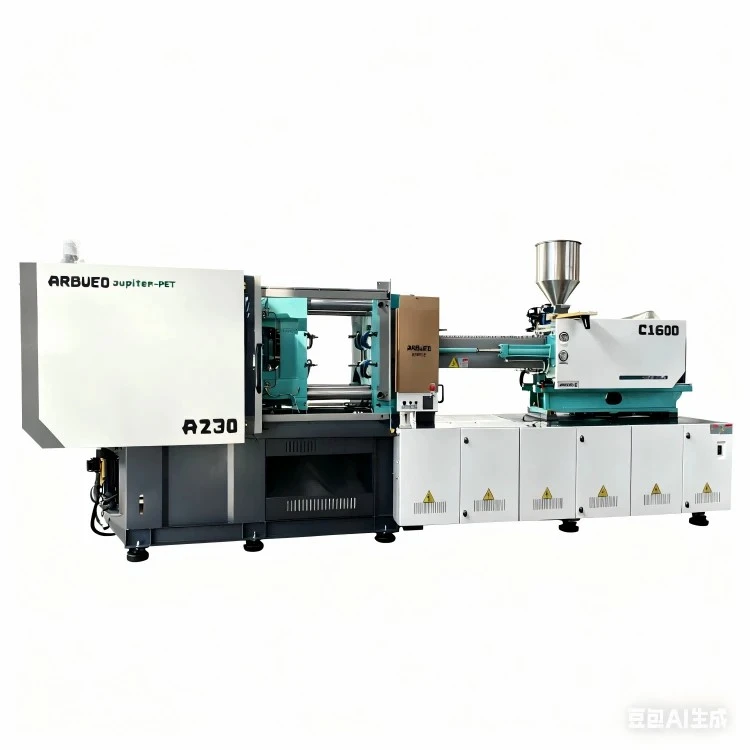
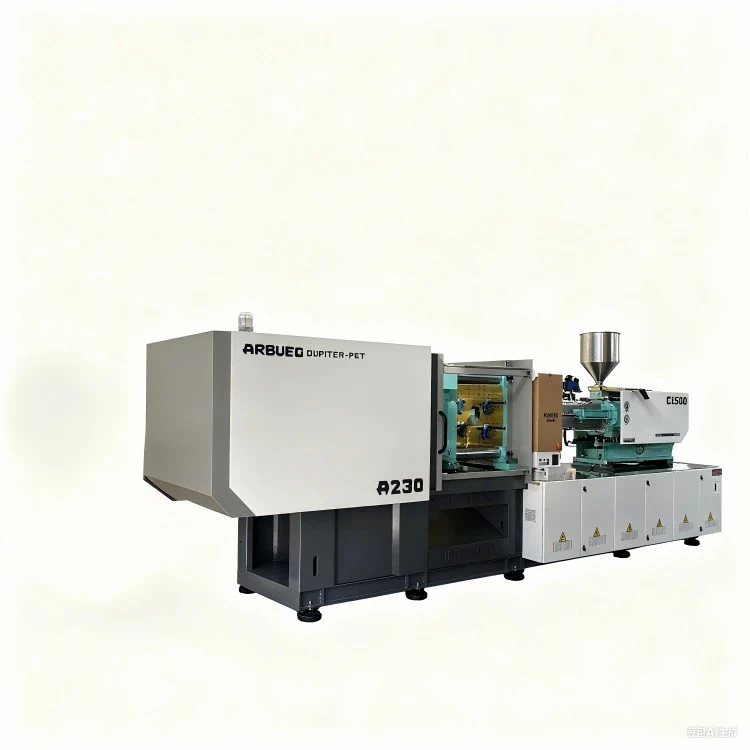
1600-Ton Injection Molding Machine
The 1600-Ton Hydraulic Servo Injection Molding Machine is engineered for heavy-duty, large-scale precision molding applications. Designed for mid-to-large-size automotive parts, industrial containers, structural appliance housings, and municipal fittings, this machine balances high clamping force with low operational energy consumption.
Equipped with a high-torque electro-hydraulic servo drive system, it delivers precise repeatability, reduced cycle times, and up to 30%–60% energy savings compared to conventional fixed-displacement hydraulic systems. Built around a heavy-duty toggle clamping mechanism and a high-rigidity base, it minimizes platen deflection under full tonnage, ensuring part dimensional stability and prolonging mold lifespan.
Key Specifications
Below are the standard technical specifications for the base configuration. Standard parameter adjustments and custom screw choices are available to meet specific shot-weight and pressure requirements.
|
Parameter Category |
Specification Item |
Metric Unit |
Technical Value |
|
Clamping Unit |
Clamping Force |
kN |
16,000 |
|
Opening Stroke |
mm |
1,450 |
|
|
Distance Between Tie Bars (H x V) |
mm |
1,550 x 1,450 |
|
|
Max. Mold Height |
mm |
1,500 |
|
|
Min. Mold Height |
mm |
650 |
|
|
Ejector Stroke |
mm |
350 |
|
|
Ejector Force |
kN |
310 |
|
|
Injection Unit |
Screw Diameter (A / B / C options) |
mm |
130 / 140 / 150 |
|
Theoretical Shot Volume (B Screw) |
cm³ |
8,930 |
|
|
Injection Weight (PS, B Screw) |
g |
8,125 |
|
|
Injection Pressure (B Screw) |
MPa |
165 |
|
|
Screw L/D Ratio |
L/D |
22:1 |
|
|
Max. Screw Speed |
rpm |
110 |
|
|
Power & Drive |
Servo Motor Power |
kW |
110 + 55 |
|
Heating Capacity |
kW |
75 |
|
|
System Hydraulic Pressure |
MPa |
17.5 |
|
|
General |
Oil Tank Capacity |
L |
2,200 |
|
Overall Machine Dimensions (L x W x H) |
m |
14.2 x 3.2 x 3.6 |
|
|
Overall Machine Weight |
Tonnes |
~98 |
Key Features
High-Rigidity Clamping Frame
Finite Element Analysis (FEA) optimized platen design distributes 16,000 kN of clamping force uniformly across the mold surface. This prevents center deflection, reduces flash on large-surface-area components, and extends mold boundary seal integrity.
Servo-Hydraulic Drive System
Integrates permanent magnet synchronous servo motors paired with internal gear pumps. The closed-loop pressure and flow control system responds within 40 ms, eliminating idle power draw during cooling cycles and substantially lowering oil temperature rise.
Precision Injection Unit
Twin injection cylinders ensure balanced force distribution along the screw axis during high-pressure injection. Linear guide rails support the injection unit carriage, reducing mechanical resistance and maintaining axial alignment.
Dedicated Industrial Microcontroller
Features a real-time industrial PLC interface with a 15-inch color touchscreen display. Includes profile programming for up to 10 injection stages, 5 hold-pressure stages, SPC process tracking, and storage memory for up to 200 mold setups.
Working Principle & Machine Configuration
Motion Sequence
Mold Closure: The 5-point double toggle mechanism advances the moving platen using high-speed low-pressure control, switching seamlessly to high-pressure tonnage locking prior to injection.
Plasticization & Injection: The hydraulic motor drives the alloy screw to plasticize raw polymer pellets. Twin hydraulic cylinders push the screw forward, executing velocity-controlled injection followed by closed-loop pressure holding.
Cooling & Recovery: While the part cools in the mold, the screw rotates to meter the next shot. Backpressure is proportionally controlled to optimize melt density and degassing.
Mold Opening & Ejection: After cooling, the toggle mechanism opens the platen with soft-start braking. The central hydraulic ejector pin system actuates to release the molded part.
Core Component Selection
Hydraulic Control: Yuken / Rexroth proportional pressure and flow valves
Servo System: Phase / Inovance servo motors paired with high-efficiency gear pumps
Platens & Tie Bars: Cast steel platens (QT500-7); 40Cr steel tie bars with hard chrome plating and high-frequency induction hardening
Electrical & Automation: Schneider AC contactors, Omron controllers, Mirle or Techmation PLC control interfaces
Linear Transducers: Novotechnik / Gefran position sensors on clamping, injection, and ejection axes
Product-Specific Technical Advantages
Reduced Platen Deflection & Flash Prevention
Large-format moldings often suffer from parting-line flash due to center platen bowing under high clamping loads. By applying boxed-structure platens with optimized stress rib orientation, center deflection is kept within 0.08 mm at full 1,600-ton hydraulic pressure.
Oil Temperature & Fluid Longevity Management
The closed-loop servo system generates less heat than traditional fixed-pump machines. Lower oil operational temperatures (typically kept under 45°C) preserve hydraulic seals, maintain consistent fluid viscosity, and double the service interval of hydraulic oil.
Screw & Barrel Wear Resistance Options
For glass-fiber filled compounds (e.g., 30% GF PP or PA66), standard nitrided screws experience accelerated wear. We offer bimetallic alloy barrels with tungsten carbide screw flights, increasing wear life by 3 to 5 times when processing abrasive resins.
Typical Applications
Automotive Exterior & Interior Parts
Large bumper fascia cores, dashboard structural supports, door panel carriers, wheel arch liners, and engine undertrays.
Industrial Packaging & Logistics
High-density polyethylene (HDPE) shipping pallets, heavy-duty collapsible crates, storage totes, and municipal waste containers (240L to 660L).
Municipal & Building Infrastructure
Large PVC/PPR pipe fittings, inspection chambers, drainage channels, and septic tank structural components.
Commercial & Home Appliances
Outer tubs and structural bases for washing machines, air conditioner outdoor unit housings, and television back panels.
Material Compatibility
|
Resin Type |
Typical Shrinkage (%) |
Melt Temp Range (°C) |
Machine Configuration Requirement |
|
Polypropylene (PP) |
1.0 – 2.5% |
200 – 260°C |
Standard screw profile; high cooling capacity mold circuits. |
|
High-Density Polyethylene (HDPE) |
1.5 – 3.0% |
190 – 240°C |
High plasticizing torque screw option; accurate backpressure control. |
|
ABS / PC+ABS Alloy |
0.4 – 0.7% |
230 – 270°C |
Decompress function to prevent drooling; precise multi-stage hold pressure. |
|
Polyamide (PA6 / PA66 + GF) |
0.3 – 1.2% |
260 – 310°C |
Bimetallic wear-resistant screw and barrel; ceramics heating bands. |
How to Select / Configuration Optionson
Selecting the correct specification depends on part dimensions, resin viscosity, and mold design:
Clamping Tonnage Calculation
Calculate part projected area (including runners) and multiply by material cavity pressure factor:
Required Tonnage (kN) = Projected Area (cm²) x Material Factor (3.5 – 6.5 kN/cm²)
Injection Unit & Screw Selection
A Screw (130 mm): Delivers higher injection pressure (up to 190 MPa). Ideal for thin-wall engineering plastics or long flow-length parts.
B Screw (140 mm): Standard balanced option. Optimizes injection volume and pressure for general polyolefins (PP/PE).
C Screw (150 mm): Maximizes shot volume (up to 10,200 cm³). Recommended for thick-walled industrial parts requiring high material volume at moderate injection pressure.
Optional Features
Multi-circuit hydraulic core pull units (up to 4 valves)
Valve gate sequential injection control (air or hydraulic actuation)
Accumulator-assisted high-speed injection (for thin-wall packaging)
Magnetic platen clamping systems for rapid tool changes
Manufacturing & Quality Control
Heavy Machining Infrastructure
All machine frames undergo stress-relief annealing after welding to eliminate internal material tension. Precision boring of platen pin holes and tie bar guides is performed on large floor-type CNC horizontal boring mills to guarantee strict parallelism.
[Frame Welding & Stress-Relief Annealing]
↓
[Floor-Type CNC Horizontal Boring & Milling]
↓
[Laser Tracker Parallelism Alignment]
↓
[Dry Cycle & Full-Tonnage Hydraulic Pressure Test]
Inspection Criteria
Platen Parallelism: Checked via optical laser alignment tools; maintained within 0.15 mm across full platen area during motion.
Tie Bar Alignment & Tensioning: Electronic strain gauges measure equal load distribution across all four tie bars under full locking pressure.
Pressure Hold & Leak Testing: Hydraulic manifold blocks undergo 24-hour high-pressure hold tests to verify zero oil leakage at seal boundaries.
Continuous Dry-Run Testing: 72-hour uninterrupted dry-cycling before shipment to verify controller stability, oil thermal balance, and mechanical sensor repeatability.
Customization & OEM Support
We provide tailored engineering adjustments to match specific plant layouts and production lines:
Extended Daylight & Stroke: Custom tie bar lengths and extended opening strokes for deep-draw parts or stack molds.
Specialized Screw Designs: Dedicated mixing head geometries, barrier screws for color dispersion, or vented barrels for moisture-sensitive materials.
Euromap / SPI Standards: Robot interface integration (Euromap 67 or Euromap 12), SPI platen bolt-hole patterns, and standardized core-pull signaling.
Voltage Adjustments: Transformer integration for global electrical standards (e.g., 480V 60Hz North America, 380V 50Hz Europe, 415V Australia).
What Buyers Should Provide for a Quote
To receive an accurate commercial quotation and technical specification sheet, please provide the following project details:
3D Part Files or Drawings: STEP/IGES format detailing part dimensions, wall thickness, and weight.
Resin Specification: Material grade, density, and shrinkage rate (e.g., SABIC PP 575P with 20% Talc filler).
Mold Dimensions: Length, width, height, and total mold weight. Include core-pull requirements if applicable.
Target Cycle Time & Annual Volume: Desired production output to help evaluate motor size and plasticizing capacity options.
Plant Power Supply: Local voltage (V), frequency (Hz), and phase configuration.
FAQ
Q: What is the typical lead time for a 1600-ton machine?
A: Standard production time is 60 to 75 days following technical drawing sign-off and deposit confirmation. Specialized customizations (e.g., extended tie bar clearance or custom injection units) require 80 to 90 days.
Q: How is the machine transported to overseas facilities?
A: Due to its dimensions (~98 tonnes total weight), the machine is disassembled into modular shipping units: clamp assembly, injection base, and hydraulic power unit. Transport is arranged using flat-rack and open-top containers.
Q: What warranty coverage and spare parts are provided?
A: The machine includes a 12-month full-machine warranty and a 24-month structural warranty on platens and tie bars. A standard spare parts kit (heating bands, thermocouples, hydraulic seal rings, and proximity switches) is included with delivery.
Q: Can this machine integrate with industrial automation robots?
A: Yes. The control system supports standard Euromap 67 and Euromap 12 interfaces, allowing direct communication with top-entry, side-entry, and 6-axis articulation robots for automated part extraction.
Q: What maintenance routines are required for the hydraulic system?
A: Filter elements should be inspected after the initial 500 operating hours and replaced every 2,000 hours thereafter. Hydraulic oil testing should be conducted annually to verify cleanliness (target ISO 4406 18/16/13) and fluid performance.
Hot Tags: 1600 ton injection molding machine, China 1600 ton injection molding machine manufacturers, suppliers, factory


