


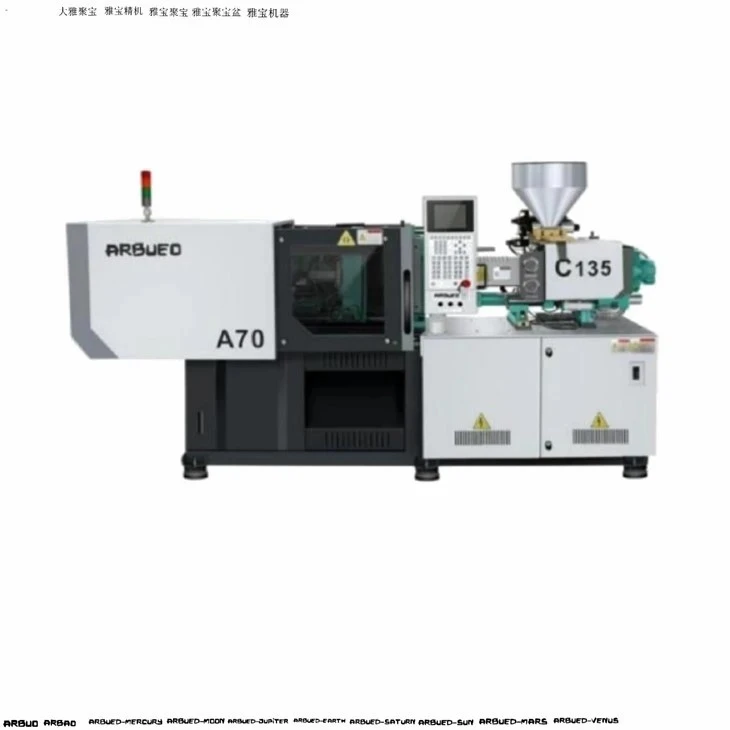


High-Speed Hybrid Injection Molding Machine
High-speed hybrid injection molding machines integrate electric servo drives for clamping and plasticizing with precision hydraulic systems for high-pressure injection and ejector movements. This drive configuration combines the dynamic acceleration, positional accuracy, and energy efficiency of electric motion with the high force density and hydraulic holding power required for thin-wall and fast-cycle production.
Engineered specifically for short cycle times (sub-3 seconds in packaging and medical disposables) and strict wall-thickness tolerances, these machines optimize energy usage by up to 50% compared to traditional fully hydraulic platforms while maintaining continuous, heavy-duty operation in multi-cavity manufacturing environments.
Key Specifications
Below are the core technical parameters across the standardized high-speed hybrid platform range:
|
Technical Parameter |
Unit |
Standard Value Range |
Notes / Conditions |
|
Clamping Force |
kN (Ton) |
1,800 - 6,500 (180 - 650 T) |
Toggle-lever mechanism |
|
Injection Speed |
mm/s |
300 - 800 |
Dynamic hydraulic accumulator assisted |
|
Screw Diameter Options |
mm |
32 / 38 / 45 / 52 / 60 |
Nitrided / Bimetallic selection |
|
L/D Ratio |
L/D |
20:1 - 24:1 |
Optimized for melt homogeneity |
|
Max. Injection Pressure |
bar |
2,000 - 2,500 |
Application-dependent |
|
Dry Cycle Time |
s |
1.2 - 2.1 |
EUROMAP 6 standards |
|
Platen Dimensions (H x V) |
mm |
780x780 to 1,350x1,350 |
Standardized T-slot layout |
|
Tie-Bar Clearance |
mm |
530x530 to 920x920 |
Enables wide multi-cavity mold fitting |
|
Ejector Force / Stroke |
kN / mm |
50-120 / 150-220 |
Servo-hydraulic or electric driven |
|
System Power Supply |
V / Hz |
380-480V, 3-Phase, 50/60Hz |
Configurable to regional standards |
Key Features
Hybrid Servo Drive Architecture: AC electric servo motors power screw rotation (dosing) and clamp movements independently, enabling simultaneous plasticizing during mold cooling without hydraulic oil degradation.
Accumulator-Assisted Injection Unit: Dual hydraulic accumulators deliver instantaneous flow rates for ultra-high-speed melt front advancement, eliminating short shots on wall thicknesses below 0.4 mm.
Rigid Platen and Toggle Geometry: Finite Element Analysis (FEA)-optimized platen structures minimize deflection under maximum clamping force, protecting precise multi-cavity parting lines.
Closed-Loop Motion Control: Real-time feedback via optical linear encoders ensures repeatability within +/- 0.01 mm for injection transition points and clamp positions.
Integrated Energy Regeneration: Kinetic energy generated during deceleration phases of clamp movements is converted and fed back into the DC bus drive unit.
Machine Configuration
Clamping Mechanism: Five-point double-toggle system driven by a dedicated AC servo motor with automatic centralized lubrication and digital clamping force monitoring.
Injection Unit: Linear guide-mounted injection sled driven by dual hydraulic cylinders backed by nitrogen-charged bladder accumulators for rapid velocity step-response.
Plasticizing System: Bimetallic barrel paired with a high-torque electric servo drive for high-rpm dosing independent of hydraulic system load.
Hydraulic Manifold: Proportional valves mounted directly adjacent to injection cylinders to minimize hydraulic fluid lag and pressure drop.
Control System: Industrial PLC interface with a 15-inch multi-touch display, supporting real-time process curve tracking, EUROMAP 63/77 integration, and SPC monitoring.
Product-Specific Technical Advantages
Simultaneous Motion Control
Electric screw drive allows continuous plasticizing while the clamp opens, ejects parts, and closes. This eliminates plasticizing time from the total cycle phase, saving 0.5 to 2.5 seconds per shot depending on resin wall thickness.
Precise Melt Temperature Management
Independent electric dosing control maintains constant screw torque and backpressure regardless of injection speed profiles. Thermal degradation of shear-sensitive engineering resins is prevented via PID multi-zone ceramic heating bands combined with solid-state relay switching (+/- 1 degree C control precision).
Thermal Fluid Stability
Because hydraulic power is reserved exclusively for high-force short-duration movements (injection and clamping lock), hydraulic oil thermal loading is minimized. Cooler oil operating temperatures (kept below 45 degrees C) prolong hydraulic seal life, reduce oil oxidation rates, and lower chiller energy demand.
Typical Applications
Packaging & Containers
Thin-wall Food Containers & Lids: Wall thicknesses down to 0.35 mm; 4-cavity to 32-cavity molds with cycle times under 3.0 seconds.
Closure Systems & Caps: High-cavitation molds requiring continuous multi-axis movement (in-mold labeling and unscrewing options).
Medical & Healthcare Disposables
Syringe Barrels & Pipette Tips: High precision and flash-free tolerances executed inside Class 8 cleanroom environments.
Blood Collection Tubes: PET/PP high-cavitation molding with strict dimensional consistency.
Precision Electronics & Automotive Components
Connectors & Housing Frames: Thin-walled glass-filled PBT/PA66 electrical housings requiring high injection pressures to complete fill without sink marks.
Material Compatibility
Polypropylene (PP) & Polyethylene (PE): High MFI grades optimized for ultra-fast cycle thin-wall injection.
Polystyrene (GPPS/HIPS) & ABS: High optical clarity or high-impact parts requiring precise hold-pressure transitions.
Polycarbonate (PC) & Polyamide (PA6/PA66 with GF): High-temperature engineering plastics requiring rigid pressure stability and wear-resistant bimetallic plasticizing components.
Polyethylene Terephthalate (PET): Dedicated screw profiles available for low-Acetaldehyde (AA) generation preform and container moulding.
Configuration Options
To tailor the base platform to specific production parameters, purchasers can select from the following functional modules:
Screw & Barrel Options
Standard Wear-Resistant Bimetallic: Designed for resins containing 15%–25% glass fiber reinforcement.
Fully Corrosion-Resistant Alloy: Engineered for processing flame retardants, PVC, and highly corrosive additive packages.
High-Mix Homogenizing Screw: Optimized for high-pigment masterbatch mixing and uniform color dispersion.
Auxiliary Motion & Hydromechanical Options
Hydraulic Core Pulling Circuits: Configurable from 1 to 4 independent hydraulic valve sequences.
Servo-Electric Ejection: Designed for parallel ejector motion during mold opening and cleanroom compliance.
Air Blow Valves: Multi-circuit pneumatic valves with fully configurable timing and pressure settings.
Automation & Control Integration
Integrated In-Mold Labeling (IML) Interface: Standardized EUROMAP 67 integration for high-speed labeling robotics.
Robot Pick-and-Place Interface: Standardized EUROMAP 12 automation interface for part extraction systems.
Integrated Hot Runner Controllers: Built-in temperature control modules supporting 12 to 48 independent heating zones.
Manufacturing & Quality Control
Every machine undergoes strict testing protocol before dispatch to ensure structural compliance and positional precision:
Machine Bed Fabrication: Stress-relieved steel weldments subjected to thermal annealing prior to CNC portal milling to guarantee tie-bar alignment stability over extended operation.
Platen Parallelism Verification: Parallelism measured under 100% clamping load using dial indicators; maximum allowable deviation is within 0.05 mm across diagonal span.
Dry Cycle Testing: 48-hour continuous burn-in dry cycling under maximum speed settings to verify hydraulic thermal equilibrium, drive response, and zero-leak seal integrity.
Laser Interferometer Alignment: Linear axes laser-calibrated to ensure spatial accuracy and absolute positioning repeatability.
Quality Certifications: ISO 9001:2015 manufacturing standard compliance; CE mark verification according to Machinery Directive 2006/42/EC and EN 201 safety requirements for plastics machinery.
Customization & OEM Support
Cleanroom Package for Medical Disposables (ISO Class 8 / GMP Compliant)
For medical device manufacturers operating under cleanroom conditions, the hybrid injection molding platform offers a specialized contamination-control configuration designed to satisfy ISO 14644-1 Class 8 standards:
Enclosed & Lubricant-Free Clamping Zone: Tie-bars are treated with wear-resistant chrome plating and utilize food-grade, grease-sealed linear bearings to prevent oil droplet aerosolization near the mold interface.
Stainless Steel Paneling & Cleanable Surfaces: Frame covers and side panels are executed in brushed AISI 304 stainless steel with smooth, radius-cornered geometry to eliminate dust-trapping crevices and allow frequent chemical wipe-downs (IPA/peroxide compatible).
Part Discharge & Conveyor Integration: Features an integrated laminar airflow hood mount directly above the mold clamping zone, ensuring positive pressure protection during part drop and automated robot pickup (EUROMAP 67 cleanroom interface).
Non-Contaminating Hydraulic Circuit: Hydraulic lines inside the clean zone use double-braided stainless steel hoses with dry-break quick couplings, certified NSF H1 food-grade fluid, and centralized HEPA-filtered oil tank breathers.
Additional Custom Engineering
Custom Screw & Barrel Metallurgy: Specialized coatings (such as Tungsten Carbide cladding) designed for resins containing up to 50% glass fiber reinforcement or corrosive additives.
Extended Daylight & Tie-Bar Spacing: Platen modifications to accommodate bulky stack molds, complex core-pull molds, or deep-draw components.
Custom Control Protocol Integration: Support for OPC UA communications, custom MES integration protocols, and specific factory automation standards.
What Buyers Should Provide for an Accurate Quote
To receive a detailed technical configuration and commercial proposal, please include the following technical inputs in your inquiry:
Part Geometry & Drawing: 3D STEP/IGES files or 2D dimensioned drawings detailing maximum and minimum wall thickness.
Resin Specification: Material grade, MFI/MFR, and percentage of additives/fillers (e.g., glass fiber, flame retardants).
Mold Specifications: Number of cavities, total shot weight (g or cm3), mold weight, and external mold dimensions (LxWxH).
Target Cycle Time: Required part output rate (parts/hour) or target overall cycle duration.
Auxiliary Requirements: Need for integrated hot runner control, core pulls, valve gates, or robot automation interfaces (EUROMAP 67/77).
FAQ
Q: What is the primary difference between a hybrid injection molding machine and a fully electric machine?
A: A hybrid machine utilizes electric drives for continuous/high-frequency tasks (screw rotation and clamp movement) and hydraulic power for high-dynamic/high-force tasks (injection and holding). Fully electric machines use servo motors and ball screws for all axes. Hybrids deliver significantly higher injection speeds and force density at a lower initial equipment cost for high-pressure thin-wall applications, whereas fully electrics excel in absolute zero-oil cleanroom operation.
Q: How does a hybrid system lower operational energy consumption?
A: Energy savings occur because the electric plasticizing drive runs independently without using hydraulic power. Furthermore, the main hydraulic pump uses a servo drive that completely shuts down or operates at minimal RPM during holding and cooling phases, eliminating the continuous idle power losses typical of fixed-displacement hydraulic pumps.
Q: What maintenance protocol is required for the hydraulic accumulators?
A: Bladder accumulators require periodic checking of their nitrogen pre-charge pressure. Inspections should be conducted every 6 months using standard charging and testing equipment. Nitrogen pressure levels must be maintained according to factory ratings to ensure consistent injection acceleration speeds.
Q: Can this platform handle abrasive glass-filled materials?
A: Yes. When processing glass-filled or abrasive materials, machines are equipped with specialized bimetallic barrels (matrix with tungsten/boron carbide alloys) and fully hardened screw flights. This prevents premature wear and maintains stable plasticizing efficiency over long production runs.
Hot Tags: high speed hybrid injection molding machine, China high speed hybrid injection molding machine manufacturers, suppliers, factory, Thin Wall Plastic Container Injection Molding Machine


