


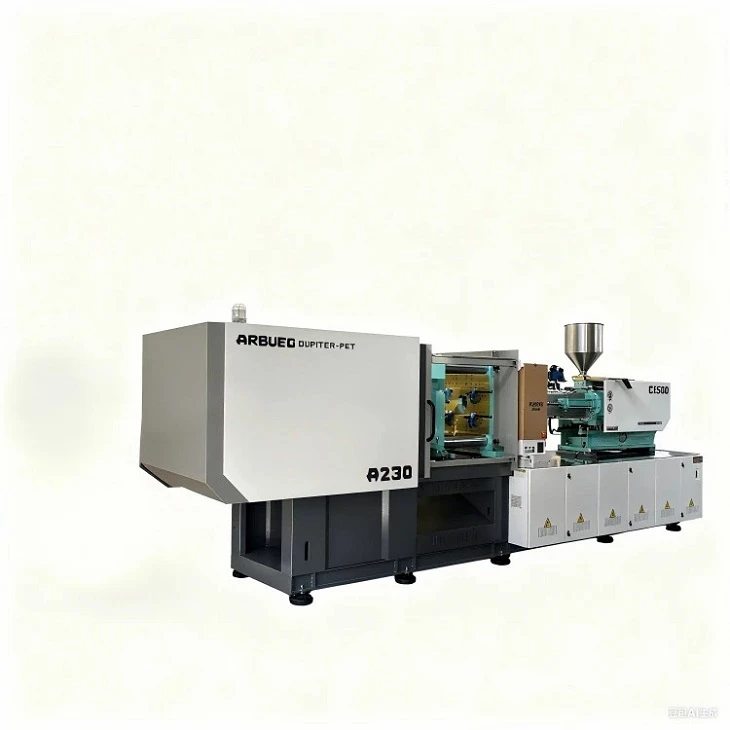
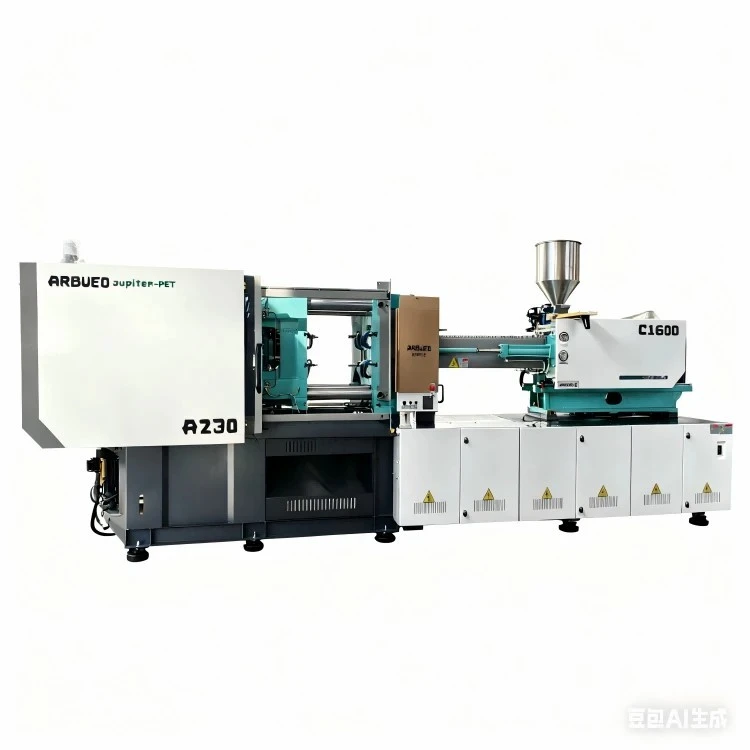
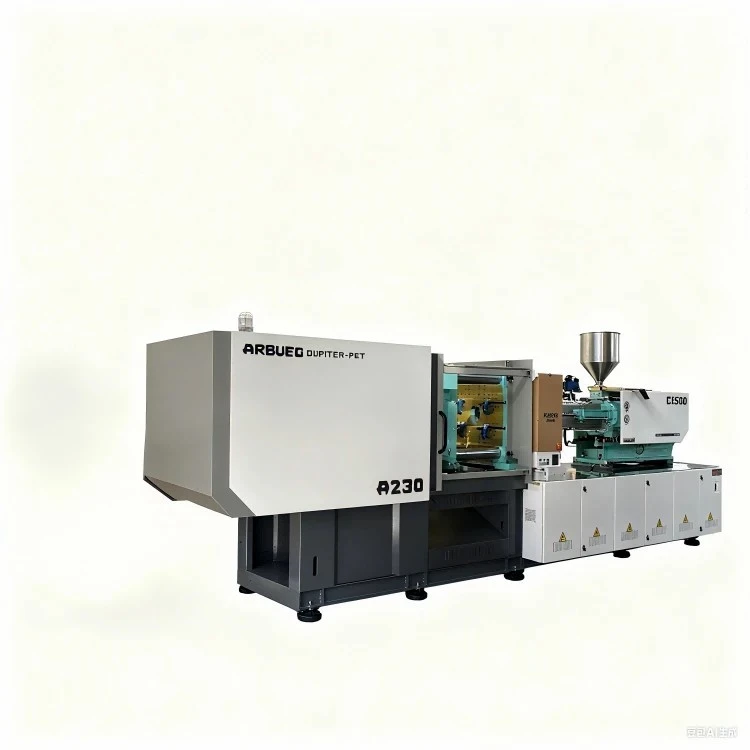
High-Precision Hybrid Injection Molding Machine
This hybrid injection molding machine combines electric servo-driven injection with a hydraulic clamping unit. The direct servo electric drive handles plasticizing and injection, achieving repeatability within +/-0.01 mm for shot weight and position. Hydraulic tie-bar clamping provides rigid holding force for multi-cavity, high-pressure molding without high electricity consumption.
Designed for thin-wall packaging, medical components, and optical-grade electronics, this unit bridges the gap between full-hydraulic clamping stability and full-electric precision. Energy consumption is reduced by 30% to 50% compared to standard hydraulic machines, with dry cycle times lowered to under 1.2 seconds on standard models.
|
Metric |
Range / Value |
|
Clamping Force |
100 ton – 800 ton (1,000 kN – 8,000 kN) |
|
Injection Velocity |
Up to 800 mm/s (accumulator assisted) |
|
Shot Weight Repeatability |
+/-0.01% – +/-0.03% |
|
Position Accuracy |
+/-0.01 mm (Closed-loop linear optical encoder) |
|
Energy Reduction |
30% – 50% vs. variable pump hydraulics |
|
Standard Compliance |
CE, ISO 9001, ANSI/SPI B151.1 |
Key Specifications
|
Parameter |
150-Ton Model |
300-Ton Model |
500-Ton Model |
|
Clamping Force |
1,500 kN |
3,000 kN |
5,000 kN |
|
Tie-Bar Clearance (H x V) |
460 x 460 mm |
660 x 660 mm |
820 x 820 mm |
|
Platen Size (H x V) |
680 x 680 mm |
960 x 960 mm |
1,200 x 1,200 mm |
|
Mold Opening Stroke |
420 mm |
600 mm |
800 mm |
|
Max. Mold Height |
500 mm |
680 mm |
850 mm |
|
Min. Mold Height |
180 mm |
280 mm |
350 mm |
|
Screw Diameter Options |
A: 32mm / B: 36mm / C: 40mm |
A: 45mm / B: 50mm / C: 55mm |
A: 65mm / B: 70mm / C: 75mm |
|
Injection Rate (A-Screw) |
185 cm3/s (Standard) / 450 cm3/s (Acc.) |
310 cm3/s (Standard) / 600 cm3/s (Acc.) |
580 cm3/s (Standard) / 800 cm3/s (Acc.) |
|
Max. Injection Pressure |
2,350 bar |
2,150 bar |
2,000 bar |
|
Ejection Stroke |
120 mm |
160 mm |
200 mm |
|
Ejection Force |
42 kN |
78 kN |
110 kN |
Key Features
Parallel Motion Capability: Electric plasticizing runs concurrently with mold opening, ejector movements, and core-pull operations. This reduces overall cycle times by 15% to 25%.
Closed-Loop Servo Electric Injection: A high-torque servo motor directly drives the ball screw for injection acceleration (>2.0G). Pressure transducers provide real-time feedback at 1 kHz sampling rates.
Rigid Platen & Hydraulic Clamping Structure: Finite Element Analysis (FEA) optimized platens minimize deflection under full tonnage. Hydraulic clamping maintains steady stress distribution across tie-bars, extending mold tool life.
Active Energy Recovery: Brake energy generated during deceleration phases feeds back into the power circuit, decreasing thermal loading in the cabinet and cutting electrical usage.
Oil-Free Mold Area Options: Tie-bars and mold platens utilize self-lubricating graphite-impregnated bushings. This eliminates liquid lubricants inside the mold area, satisfying ISO Class 7 cleanroom demands.
Technical Advantages
Hybrid Drive Architecture
Independent drive systems handle specific kinematic demands:
Electric Axis (Plasticizing & Injection): Eliminates hydraulic fluid friction loss during high-speed injection. Response delay drops from 50 ms (hydraulic servo valves) to under 10 ms (electric servo drive).
Hydraulic Axis (Clamping & Core Pulls): Delivers precise high-pressure holding without continuous electric motor load at stall torque.
Thermal and Viscosity Compensation
Viscosity changes in raw resins caused by regrind ratios or ambient shop-floor temperature shifts are corrected automatically. Pressure sensors inside the nozzle measure actual melt pressure at peak injection. The controller modulates speed and V/P transition points shot-by-shot to ensure uniform cavity filling.
Hydraulic Oil Management
Because hydraulic power is reserved for clamping and ejection, total oil capacity is reduced by 60% compared to full-hydraulic setups. Oil operating temperatures remain below 42°C under full production, eliminating mandatory water-chilling for oil coolers and extending hydraulic fluid service life to over 20,000 operating hours.
Typical Applications
Medical Devices & Diagnostics
Components: Luer lock connectors, syringe barrels, microfluidic chips, pipette tips, blood collection tubes.
Requirements: ISO Class 7 cleanroom compliance, zero oil contamination risk, flash-free parting lines, shot weight variation below 0.05%.
Thin-Wall Packaging
Components: Food containers, tamper-evident caps, medical vials, cosmetic closures.
Requirements: Injection speeds reaching 800 mm/s, injection pressure capability up to 2,400 bar, cycle times under 3.5 seconds.
Electronics & Precision Optics
Components: Smartphone lens housings, micro-connectors, camera modules, relay bases.
Requirements: Minimal residual stress, tight pitch dimensional tolerances (+/-0.005 mm), compatibility with liquid crystal polymer (LCP) and high-temperature polyamides.
Material Compatibility
|
Resin Type |
Processing Temperature Range |
Machine Configuration Requirement |
Key Target Applications |
|
Polypropylene (PP) / Polyethylene (PE) |
180°C – 240°C |
Standard Nitrided Screw & Barrel |
Thin-wall packaging, caps, closures |
|
Polycarbonate (PC) / PMMA |
260°C – 320°C |
Bimetallic Barrel, Optical-grade Screw Geometry |
Lenses, light guides, transparent housings |
|
LCP / PPA (30%–50% Glass Filled) |
320°C – 380°C |
Wear-resistant Tungsten Carbide Screw/Tip |
Micro-electronic connectors, Bobbins |
|
ABS / PC-ABS Alloy |
230°C – 270°C |
Mixing Head Screw, Balanced Nozzle Heating |
Automotive interior trim, enclosures |
|
PEEK / PPS |
360°C – 420°C |
High-Temp Ceramic Heaters, Insulated Platens |
High-performance industrial parts |
Configuration Options
Injection Unit Options
Standard Servo-Electric: Injection speeds up to 300 mm/s. Suitable for technical parts, automotive connectors, and general precision molding.
Accumulator-Assisted Electric/Hydraulic: Injection speeds up to 800 mm/s. Designed for thin-wall molding with wall thicknesses below 0.4 mm.
Screw Barrel Metallurgies:
Class A: Nitrided steel for non-abrasive unfilled resins.
Class B: Bimetallic layer (1.5 mm thick) for resins with up to 30% glass fiber.
Class C: Tungsten carbide lined barrel and screw for abrasive/corrosive materials (LCP, fluoropolymers, >30% glass/mineral fill).
Core-Pulling and Automation Integration
Hydraulic Core Pulls: 2-circuit to 4-circuit manifold configurations mounted on moving or fixed platens.
Servo-Driven Core Pulls: Independent electric core drives for precise position tracking without hydraulic connections.
Euromap / SPI Interfaces: Euromap 63 and Euromap 73 interfaces come standard for seamless plug-and-play robot and pick-and-place integration.
Manufacturing & Quality Control
Platen Machining: Platens are cast from ductile iron (GGG50/QT500-7) and machined on 5-axis horizontal CNC machining centers in a single setup to maintain parallel tolerances within 0.02 mm/m.
Tie-Bar Finishing: 42CrMo4 high-tensile steel tie-bars undergo induction hardening (HRC 55–58) and hard-chrome plating (0.03 mm thickness) followed by centerless grinding.
In-Line Quality Audits:
Laser Interferometer Calibration: Measures position accuracy along the injection ball screw and platen travel.
Ultrasound Weld Inspection: Verifies structural integrity across all stress-bearing cast elements.
48-Hour Continuous Dry Run: Every machine completes a 48-hour continuous run cycle at maximum dry cycle speed, followed by a 4-hour hot-oil pressure test prior to shipment.
Customization & OEM Support
Factory engineering teams handle custom specifications directly:
Custom Tie-Bar Clearance: Expanded platen dimensions and widened tie-bar spacing for oversized or complex hot-runner molds.
Extended Daylight & Stroke: Custom stroke lengths for deep-draw parts or multi-stage stack molds.
Multi-Material / Multi-Shot Integration: Secondary and tertiary injection units (L-shape, Piggyback, or Vertical placement) for two-shot (2K) molding applications.
Software Integration: Open PLC architecture (Beckhoff / Keba platforms) with custom software modules for specialized pressure profile tracing and automated reject handling.
What Buyers Should Provide for a Quote
Providing the following project parameters accelerates technical evaluations and quote turnarounds:
Part Details: 2D drawings/3D CAD files (STEP, IGES), wall thickness ranges, and part weights.
Material Specifications: Grade designation, resin manufacturer, melt flow index (MFI), shrinkage rates, and fill ratios (glass/mineral %).
Mold Specifications: Number of cavities, mold dimensions (Length x Width x Height), weight, hot runner power/zone requirements, and core-pull layout.
Production Requirements: Target cycle time, daily output volume, cleanroom environment requirements (if applicable), and automation integration plans.
FAQ
Q: How does a hybrid injection molding machine differ from a full-electric machine?
A: Hybrid machines combine electric drives for high-frequency, continuous movements (plasticizing and injection) with hydraulic systems for static holding tasks (clamping force and core movement). Full-electric machines rely on electric servomotors for all axes, which increases component wear and cost when high clamp forces (>500 tons) or continuous high holding pressures are required.
Q: What maintenance schedule is required for the hybrid drive system?
A: The ball screw drive requires auto-lubrication cartridge replacements every 4,000 operating hours. The hydraulic circuit uses less oil than conventional systems; fluid replacement and filter changes are scheduled every 10,000 to 12,000 operating hours under normal conditions.
Q: What is the typical lead time for standard versus customized models?
A: Standard tonnage models (100–300 ton) ship within 30 to 45 days after final drawing sign-off. Customized units-such as those featuring specialized platen layouts, high-speed accumulator packages, or multi-component setups-require 60 to 90 days.
Q: Can this machine interface with existing automation cell controllers?
A: Yes. Systems come equipped with Euromap 63, Euromap 73, and OPC UA protocols (Euromap 77) for integration with centralized SCADA systems, peripheral equipment, and robotic arms.
Q: How is shot weight consistency guaranteed during long production runs?
A: Real-time closed-loop control tracks position, speed, and injection pressure via optical linear encoders and melt transducers. The controller adjusts injection pressure and speed profiles dynamically every millisecond to compensate for ambient thermal shifts and raw material batch variations.
Hot Tags: high precision hybrid injection molding machine, China high precision hybrid injection molding machine manufacturers, suppliers, factory


