


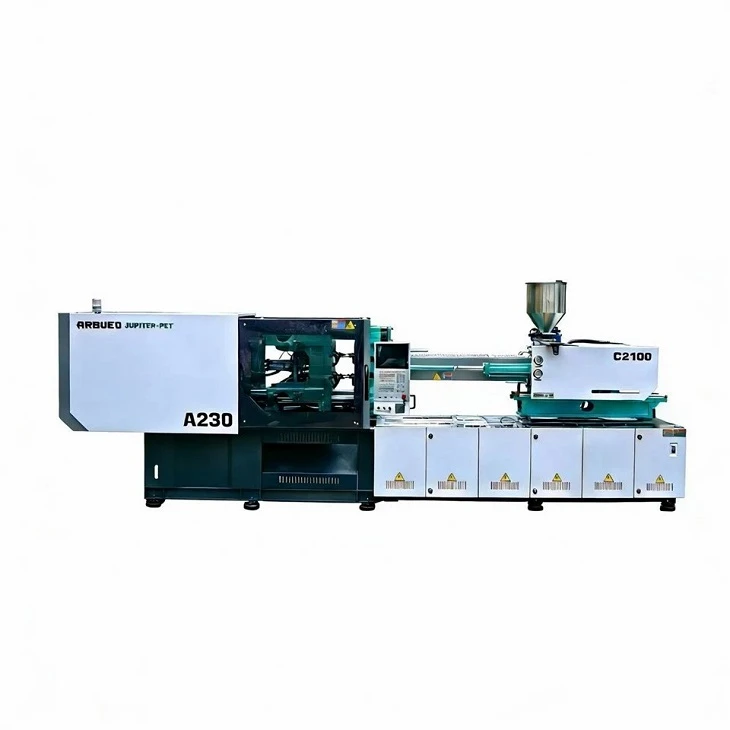
Hybrid Injection Molding Machine for High-Cycle Production
High-cycle packaging, thin-wall food containers, and medical consumables require injection molding platforms that combine fast dry-cycle speeds with rigid structural stability. This hybrid injection molding machine integrates an electric servo-driven plasticizing unit with an accumulator-assisted hydraulic injection unit.
By utilizing electric drives for continuous screw rotation while charging during clamping and cooling phases, the system reduces energy consumption by 30% to 50% compared to traditional fully hydraulic platforms. Concurrently, high-response hydraulic accumulators deliver the high injection speeds (up to 500 mm/s) and rapid response times required for thin-wall parts under 0.5 mm wall thickness without thermal degradation or short shots.
Key Specifications
|
Parameter |
Unit |
Value / Range |
|
Clamping Force |
kN / Ton |
1,600 - 8,000 / 160 - 800 Ton |
|
Injection Speed (Standard / Accumulator) |
mm/s |
300 - 800 mm/s |
|
Dry Cycle Time (Euromap 6) |
sec |
1.2 - 2.4 sec (depending on tonnage) |
|
Screw Diameter Options |
mm |
32 / 38 / 45 / 52 / 60 (L/D Ratio 22:1 - 24:1) |
|
Max. Injection Pressure |
bar |
2,000 - 2,400 bar |
|
Tie-Bar Distance (H x V) |
mm |
510x510 to 1,080x1,080 |
|
Ejector Stroke / Force |
mm / kN |
150 - 250 mm / 50 - 120 kN |
|
Ejector Response |
- |
Synchronized parallel ejector on flight |
|
Platen Parallelism (Under Load) |
mm |
Less than or equal to 0.05 mm |
|
System Energy Efficiency |
kWh/kg |
0.28 - 0.38 kWh/kg (PP material test) |
Key Features
Parallel Motion (Plasticizing during Clamp Open/Close): Electric servo drive allows continuous screw dosing during mold movement and ejection, shaving 0.8 - 1.5 seconds off total cycle time.
Closed-Loop Accumulator Injection: Twin hydraulic accumulators feed the injection cylinder directly via servo-proportional valves, achieving injection acceleration times under 20 ms.
Rigid Box-Frame Platen Structure: Finite Element Analysis (FEA)-optimized five-point toggle mechanism limits platen deflection, maintaining precise mold alignment and extending mold core/cavity lifespan.
Linear Guide Bearings on Injection Unit: High-load linear guides support the injection assembly, minimizing friction, preventing barrel tilt, and ensuring shot-to-shot consistency (weight variance within 0.2%).
Independent Servo Hydraulic Pump System: Controls clamp, core pulls, and ejector functions independently without stealing flow or pressure from plasticizing operations.
Machine Configuration
System Architecture Breakdown
Electric Drive Section (Plasticizing)
Servo Motor: Permanent magnet synchronous motor
Transmission: Heavy-duty direct gearbox
Function: Continuous parallel dosing independent of mold movements
Hydraulic Accumulator Section (Injection)
Drive Type: Nitrogen-charged bladder accumulators
Control Valve: High-response servo-proportional valves
Function: Ultra-fast injection acceleration for thin-wall filling
Real-Time PLC Control Unit
Loop Speed: 1 ms processing cycle
Control Logic: Closed-loop real-time pressure and velocity regulation
Clamping and Auxiliary System
Mechanics: Five-point twin-toggle mechanism
Structure: FEA-optimized high-rigidity box platens
Features: Automatic central lubrication and synchronized core pull interfaces
Product-Specific Technical Advantages
Ultra-Fast Injection Response Time
Thin-wall molds require immediate flow rates before the polymer melt reaches freeze-off point in thin gates. The closed-loop hydraulic accumulator system reaches peak speed within 15 ms of signal initiation, maintaining uniform wall thickness across multi-cavity parts without flash.
Hybrid Accumulator Acceleration: Peak speed reached in under 15 ms.
Standard Hydraulic Acceleration: Peak speed reached in over 80 ms.
Thermal Balance and Lower Cooling Costs
Hydraulic melt-dosing generates continuous friction in hydraulic oil, raising oil tank temperatures to over 55 Degrees C and requiring constant chilled water usage. Decoupling dosing to an electric motor drops average oil temperature to 38 - 42 Degrees C, cutting oil chiller energy loads by up to 60% and doubling seal life.
Mold Protection via High-Precision Linear Encoders
High-cycle production runs risk tool damage if a part fails to drop completely. Non-contact optical encoders constantly track platen position. If resistance rises above 0.5% of baseline parameters during mold closure, the clamp stops instantly and opens before tool damage occurs.
Typical Applications
Thin-Wall Packaging
In-Mold Labeling (IML) Containers: Margarine tubs, ice cream tubs, beverage cups (cycle times: 2.2 - 3.8 seconds).
Caps and Closures: Water bottle caps, flip-top closures with multi-cavity molds (cycle times: 2.5 - 4.5 seconds).
Disposable Food Packaging: Hinged takeaway containers, cutlery, thin-wall section lids down to 0.35 mm.
Medical Consumables
Pipette Tips and Blood Tubes: High-cavity tooling (64 to 128 cavities) requiring high shot repeatability and cleanroom compatibility (ISO Class 7/8).
Syringe Barrels and Connectors: Dimensional stability across strict tolerances.
Material Compatibility
The screw and barrel assemblies are tailored for specific resin characteristics:
|
Resin Type |
Viscosity and Processing Notes |
Screw / Barrel Configuration |
|
PP / PE |
High MFI (30 - 100 g/10min), fast freezing, requires rapid injection |
Standard nitride steel screw (SACM645) with mixer tip |
|
PET |
Hygroscopic, thermal degradation risk, high clarity requirements |
High L/D ratio (24:1), low-shear screw profile to prevent acetaldehyde (AA) build-up |
|
PS / ABS |
Brittle melt, precise heat profile required |
Bimetallic alloy barrel with anti-corrosive coating for prolonged life |
|
PLA / Bio-resins |
Shear-sensitive, strict temperature windows |
Custom shear-reduction flight geometry with precise barrier zones |
Configuration Options
To tailor the machine to specific plant layouts and production goals, buyers select from standard options:
Screw and Barrel Assemblies
Standard Nitrided: Suitable for non-abrasive commodity resins (PP, PE, PS).
Bimetallic Barrel and Fully Hardened Screw: Carbide lining for resins containing up to 30% glass fiber or abrasive mineral fillers.
Corrosion-Resistant Stainless Assembly: Specialized for medical-grade processing or PVC additives.
Hydraulic and Pneumatic Interfaces
Integrated Air Blow Valves: Up to 8-channel independent air blow circuits for part ejection or mold actuation.
Core Pull Modules: Single, double, or multi-stage hydraulic core pulling controlled via PLC software profiles.
Robot Interface: EUROMAP 67 or EUROMAP 73 standard 50-pin interface for side-entry or top-entry automation systems.
Manufacturing & Quality Control
Quality Assurance Workflow
Machining: Heavy castings -> Thermal/Natural Stress Relief -> Multi-Axis CNC Precision Milling
Assembly: Linear Guides & Hydraulic Manifolds Installed -> Electrical Wiring & Encoders Setup
Validation: 24-Hour Continuous Dry Run Testing -> Laser Interferometer Platen Alignment
Final Acceptance: Full-Load Mold Testing -> Injection Speed & Pressure Verification
Factory Inspection Protocols
Cast Stress Relief: Machine frames and platens undergo natural and thermal stress-relieving aging cycles to eliminate residual casting stresses before precision CNC machining.
Laser Interferometer Alignment: Platen alignment, tie-bar parallelism, and linear guide straightness are verified using laser measurement units under zero-load and clamping-load conditions.
24-Hour Dry Run Testing: Prior to shipment, machines undergo a continuous 24-hour dry run at maximum operating speeds to monitor thermal stability, hydraulic pressure curves, and electrical component heat generation.
Customization & OEM Support
We support turnkey projects for specialized high-speed production lines:
Custom Tie-Bar Clearances: Extended daylight and tie-bar spacing options for large multi-cavity or deep-draw molds.
In-Mold Labeling (IML) System Integration: Signal synchronization between robot controllers, static eliminators, label feeders, and machine clamp signals.
Cleanroom Execution: Stainless steel plating on platens, non-paint structural covers, closed lubrication recovery, and food-grade hydraulic oils (NSF H1).
What Buyers Should Provide for a Quote
To receive an accurate technical quotation and mold-matching analysis, submit the following technical parameters:
Part Drawings / 3D STEP Files: Wall thickness distribution, projected surface area, and part weight.
Material Grade: Specific resin trade name, MFI (Melt Flow Index), and any filler percentage (glass fiber, talc, calcium carbonate).
Mold Details:
Number of cavities.
Mold dimensions (Length x Width x Height) and stack height.
Hot runner system specification (gate type, valve gate control requirements).
Target Cycle Time: Minimum required cycle time and target daily production volume.
Auxiliary Requirements: Robotics interface specifications, core pull sequences, air blow steps, and local electrical standards (e.g., 480V 60Hz / 380V 50Hz).
FAQ
Q: How does a hybrid injection molding machine compare to a fully electric machine for high-cycle applications?
A: Fully electric machines offer high energy efficiency and accuracy, but high-speed injection (above 400 mm/s) on thick-walled or ultra-thin parts requires heavy ball screw assemblies that can experience mechanical wear under extreme acceleration loads. The hybrid configuration combines an electric screw drive for energy efficiency with hydraulic accumulators for ultra-fast, high-pressure injection bursts without mechanical stress on ball screws.
Q: What maintenance is required for the hydraulic accumulator unit?
A: Check bladder pressure (nitrogen pre-charge) every 6 to 12 months using standard pressure gauge kits. Ensure hydraulic oil filtration levels remain at ISO 4406 16/14/11 standards or better. Servicing hydraulic filters according to maintenance schedules prevents proportional valve sticking and maintains sub-20 ms injection response times.
Q: Can this machine run standard, non-thin-wall molds?
A: Yes. The PLC controller includes selectable profiles for standard injection moulding operations. You can bypass high-speed accumulator dumping for standard speed profiles, allowing the machine to run thick-wall technical parts, automotive connectors, or household goods without over-pressurizing the mold.
Hot Tags: hybrid injection molding machine for high cycle production, China hybrid injection molding machine for high cycle production manufacturers, suppliers, factory


