


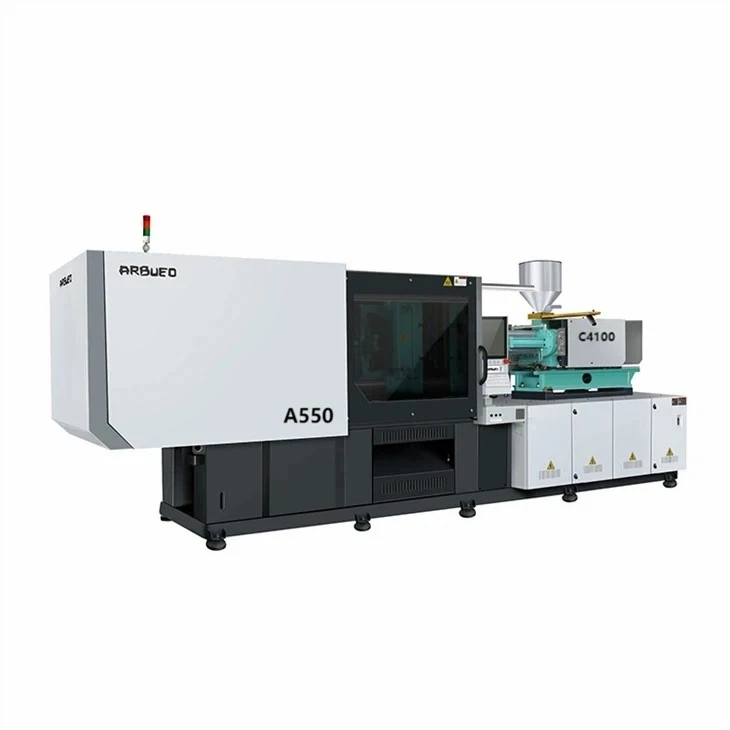
Hybrid Injection Molding Machine for Automotive Component Manufacturing
Engineered specifically for thin-wall structural components and high-precision interior/exterior automotive parts, this hybrid injection molding machine combines servo-electric screw drive technology with hydraulic clamping and injection power. It delivers positional repeatability of ±0.01 mm while reducing energy consumption by up to 45% compared to pure hydraulic systems.
Automotive component production requires tight dimensional tolerances, short cycle times, and minimal scrap rates across continuous 24/7 production runs. Traditional hydraulic machines often struggle with precision consistency and thermal stability over long production shifts, while all-electric systems face tonnage and cost constraints on thick-section structural components.
This hybrid system uses an electric servo motor for continuous plasticizing, decoupling the dosage phase from hydraulic operations. Hydraulic pressure drives mold clamping, core pulls, and high-speed injection unit movement. This hybrid architecture eliminates oil overheating caused by proportional valve throttling during plasticizing, maintains consistent melt temperature, and lowers total operating costs.
Key Specifications
|
Specification Parameter |
Value Range / Metric |
Engineering Notes |
|
Clamping Force |
2000 kN - 10,000 kN (200 - 1000 Ton) |
Direct-hydraulic toggle or two-platen locking structure |
|
Injection Speed |
Up to 350 mm/s (Standard) / 800 mm/s (Accumulator) |
Nitrogen accumulator support for ultra-thin wall parts |
|
Screw Diameter Options |
Ø 45 mm - Ø 105 mm |
Nitrided or bimetallic options available based on resin |
|
Theoretical Shot Capacity |
320 cm³ - 4200 cm³ |
Calculated at PS equivalent density |
|
Ejection Stroke |
150 mm - 350 mm |
Hydraulic ejector pin plate with adjustable force control |
|
Tie-Bar Distance (H×V) |
560×560 mm - 1180×1080 mm |
Accommodates multi-cavity automotive molds and core sliders |
|
Drive System |
AC Servo Electric (Dosage) + Servo Hydraulic (Clamp/Inject) |
Dual-loop closed controller with proportional relief valve |
Key Features
Decoupled Parallel Operations: The electric plasticizing drive runs independently of hydraulic functions, enabling parallel recovery during mold opening and ejector movements to shorten dry cycle times.
Closed-Loop Injection Controller: High-response optical linear encoders track injection position with ±0.005 mm measurement resolution, reducing part-to-part weight variations.
Adjustable Core-Pull Hydraulics: Programmable dual hydraulic core pulls integrated directly into the machine controller handle complex sliders and undercuts in door panels and instrument clusters.
Low-Oil Hydraulic System: Variable-displacement servo pumps operate on demand, maintaining hydraulic oil temperature below 45°C without large water-cooling towers.
Machine Configuration
The machine separates high-torque rotational work (screw rotation) from dynamic force work (clamping and dynamic injection) across four core operational sub-assemblies:
Servo Electric Dosage Drive: Drives the constant-torque plasticizing screw directly via an independent AC servo motor. This decouples dosage from hydraulic pressure drops, maintaining stable melt homogeny and uniform dosage times regardless of parallel machine movements.
Hydraulic Servo Accumulator: Powering the injection cylinder, this unit utilizes precise Velocity/Pressure (V/P) switch control to supply high-speed, high-pressure dynamic injection performance for thin-wall structural components.
Two-Platen Clamping Unit: Combines dynamic hydraulic tie-bar locking with automated mold height adjustment, ensuring fast, low-pressure mold protection and uniform clamp force distribution across the mold face.
Central Controller: Operates over a high-speed EtherCAT bus network, aggregating real-time sensor feedback from all linear encoders, pressure transducers, and temperature zones at 1 ms sampling intervals for closed-loop motion control.
Product-Specific Technical Advantages
±0.01 mm Position Repeatability: Direct-drive rotary encoders on the clamping unit reduce flash formation on multi-cavity automotive connectors and lighting housings.
Energy Savings: Operating power drops to zero during holding and cooling phases, reducing kVA load profiles by 30% - 45% compared to fixed-displacement pump hydraulic systems.
Linear Injection Speed Profiles: Accumulator-assisted injection maintains uniform flow front velocity through long flow-length paths, eliminating weld line defects on bumper fascia and A/B/C pillar trims.
Reduced Resin Degradation: Electric plasticizing provides precise back-pressure regulation down to 5 bar, preventing polymer chain scission in shear-sensitive filled engineering resins.
Typical Applications
Exterior Automotive Components
Front Grilles & Bumper Inserts: High flow rate requirements over long flow paths without surface sink marks.
Wheel Arch Liners: Molded using recycled PP/EPDM compounds requiring stable torque delivery during plasticizing.
Interior Trim & Structural Parts
Door Panel Sub-Assemblies: Multi-point hydraulic core-pull sequences for undercuts and mounting clip bosses.
Instrument Panel Supports: Long-glass-fiber reinforced PP components requiring gentle screw geometries to preserve fiber length.
Automotive Lighting & Electrical
Headlamp Lens Housings: Low-vibration clamp movement to maintain high optical clarity in transparent PC/PMMA resin.
Engine Bay Junction Boxes: PBT/PA66 flame-retardant materials requiring high injection pressures to fill thin rib sections.
Material Compatibility
|
Resin Type |
Processing Temperature Range |
Recommended Screw Configuration |
Specific Automotive Application |
|
PP + 30% Talc / EPDM |
210°C - 250°C |
Standard nitrided screw with mixing head |
Instrument panels, door trims |
|
PA66 + 30% GF |
270°C - 310°C |
Bimetallic barrel, tungsten carbide flight tips |
Under-the-hood brackets, connectors |
|
PC / ABS Alloy |
250°C - 280°C |
Medium-shear screw with low-compression flight |
Center consoles, glove box covers |
|
PMMA / PC |
240°C - 290°C |
High-gloss surface screw, chrome-plated barrel |
Rear lamp lenses, optical light guides |
|
POM |
190°C - 210°C |
Anti-corrosive alloy screw, check valve ring |
Automotive gears, seatbelt clips |
Configuration Options & Selection Matrix
To select the correct machine configuration, match your target component specifications using the three-step guide below:
Calculate Required Clamping Force
Use the following formula to estimate the minimum clamping tonnage needed for your mold:
Clamping Force (in kN) = Projected Area of Part (in cm²) × Cavity Count × Cavity Pressure Factor (30 to 60 MPa depending on resin viscosity)
Determine Injection Velocity Requirement
Select the appropriate injection system dynamic response based on component wall thickness:
Standard Interior & Exterior Trim (Wall thickness < 2.5 mm): Standard Hydraulic Servo Drive System.
Thin-Wall Optical, Lighting, or Connector Parts (Wall thickness < 1.2 mm): Nitrogen Accumulator Assist Package (delivers injection speeds exceeding 500 mm/s).
Choose Barrel & Screw Assembly Based on Resin Fillers
Select the cylinder metallurgy to match the chemical and mechanical abrasiveness of your polymer grade:
Unfilled Resins (Standard ABS, PP, PC): Standard Nitrided Steel Assembly (SACM 645).
Glass Fiber or Mineral Filled Compounds (>15% Filler Content): Bimetallic Barrel with Tungsten Carbide Coated Screw Flights.
Optional Packages
Sequential Valve Gating (SVG): Integrated 4 to 12 zone pneumatic/hydraulic valve gate control interface for runnerless molds.
Automated Integrated Robot Interface: Euromap 67 / SPI standard plug-and-play connections for 3-axis servo robot part extraction.
Magnetic Platen System: Reduces mold changeover time from 45 minutes to under 5 minutes on small-to-medium lot sizes.
Manufacturing & Quality Control
Every machine undergoes standardized manufacturing testing protocols prior to shipping:
Platen Parallelism Verification: Machined platens are measured under full lockup clamping tonnage using electronic dial indicators. Parallelism remains within ≤ 0.05 mm/m.
Stress-Relieved Frame Construction: Machine beds undergo thermal stress relief annealing to prevent structural deformation over long operational lifetimes.
Hydrostatic Testing: All hydraulic manifolds, valves, and hard piping are pressure-tested to 300 bar to prevent seal leaks under continuous thermal stress.
48-Hour Factory Acceptance Run: The machine operates continuously for 48 hours with oil temperature monitoring, verifying noise levels below 72 dBA and temperature stability within ±2°C.
Customization & OEM Support
Specialized Screw Geometries: Barrier screws, vented barrels for moisture evacuation without pre-drying, and specialized mixer tips for masterbatch distribution.
Custom Tie-Bar Clearances: Extended distance between tie-bars to accommodate large slide boxes and deep core automotive molds.
Multi-Material Injection Upgrades: Secondary hydraulic or electric injection units (L-shape, Piggyback, or Vertical placement) for two-shot (2K) molding applications.
Control System Integration: Customized PLC software interfaces tailored to factory-wide SCADA, Euromap 63/77 protocol, or MES database integration.
What Buyers Should Provide for a Detailed Quote
Provide the following technical data to receive an itemized machine proposal and cycle time simulation within 24 hours:
Part Drawings / CAD Files: 3D STEP or IGES files including wall thickness, projected surface area, and overall dimensions.
Resin Grades: Specific resin brand, grade designation, and filler percentages (e.g., Sabic PP 108MF97 with 20% Talc).
Mold Dimensions & Layout: Mold height (min/max), weight, cavity count, runner type (cold vs. hot runner), and core-pull valve counts.
Required Production Output: Target cycle time, daily volume requirements, and secondary automation details (e.g., IML, robot pick-and-place).
Plant Utility Voltage: Local power line specifications (e.g., 480V/60Hz/3 Phase or 380V/50Hz/3 Phase).
FAQ
Q: How does a hybrid injection molding machine compare to an all-electric machine for automotive parts?
A: Hybrid machines offer higher injection speeds and force capabilities for thick-section structural parts or large interior panels at a lower capital cost than all-electric machines of equivalent clamp tonnage. They retain electric motor efficiency during plasticizing while using hydraulic pressure for clamping force and core pulls.
Q: What maintenance interval is required for the hydraulic servo system?
A: Hydraulic oil filtration elements should be replaced every 2,000 operating hours. Oil sampling for particulate contamination and water content should occur every 4,000 hours. Proper oil maintenance extends pump and valve operational lifespans past 30,000 hours.
Q: Can this machine process resins with high glass fiber contents (30–50%)?
A: Yes. When handling reinforced engineering resins like PA66-GF30 or PBT-GF40, we supply a bimetallic barrel lined with a nickel-based alloy and a fully hardfaced tungsten carbide screw flight to prevent abrasive wear.
Q: What energy savings can be expected compared to traditional hydraulic machines?
A: Energy consumption drops by 30% to 45%. The electric plasticizing drive eliminates hydraulic conversion losses during screw rotation, and the variable-frequency hydraulic pump draws negligible power during part cooling phases.
Q: Does the controller support Euromap standards for automation?
A: Yes. The machine controller includes standard Euromap 67 interfaces for robot integration, along with Euromap 77 for data exchange with factory execution systems (MES).
Hot Tags: hybrid injection molding machine for automotive parts, China hybrid injection molding machine for automotive parts manufacturers, suppliers, factory


