


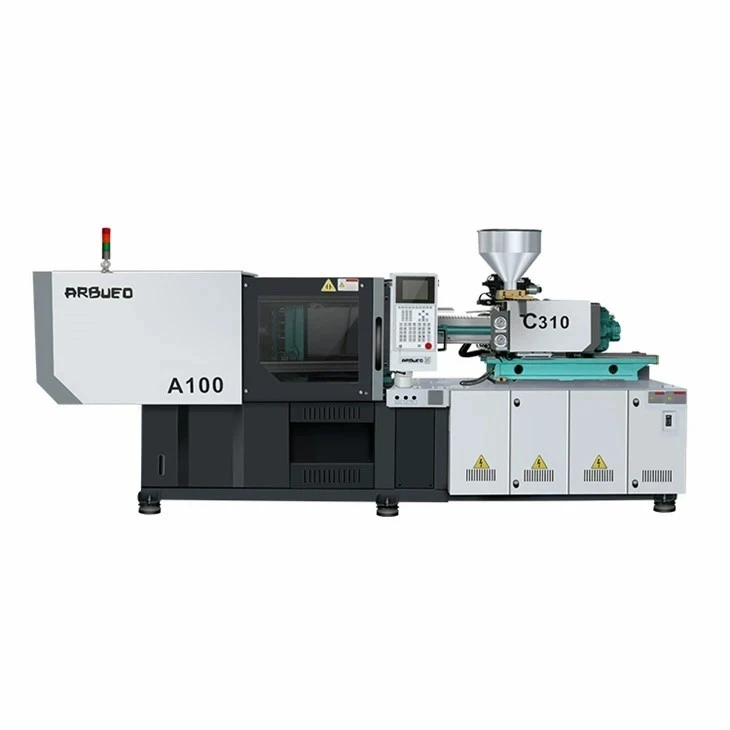
High Precision Injection Molding Machine for Electronic Components
Precision electronic manufacturing requires repeatable shot accuracy, low thermal degradation, and minimal mechanical vibration. This high-precision injection molding system is engineered for micro-components, fine-pitch connectors, relay housings, and thin-wall sensor enclosures. Combining a high-response closed-loop servo-hydraulic or all-electric injection unit with rigid clamping platens, the machine delivers a weight repeatability of <= 0.15% and shot-to-shot positional accuracy down to +/- 0.01 mm.
Key Specifications
|
Parameter |
30-Ton Model |
80-Ton Model |
150-Ton Model |
220-Ton Model |
|
Clamping Force |
300 kN |
800 kN |
1,500 kN |
2,200 kN |
|
Tie-Bar Distance (H x V) |
280 x 280 mm |
360 x 360 mm |
470 x 470 mm |
560 x 560 mm |
|
Platen Dimensions |
420 x 420 mm |
520 x 520 mm |
680 x 680 mm |
810 x 810 mm |
|
Screw Diameter Options |
14 / 18 / 22 mm |
22 / 25 / 28 mm |
28 / 32 / 36 mm |
36 / 40 / 45 mm |
|
Theoretical Shot Volume |
11.5 - 28.5 cm³ |
34.2 - 55.4 cm³ |
80.0 - 132.3 cm³ |
173.0 - 270.4 cm³ |
|
Max. Injection Pressure |
2,800 bar |
2,500 bar |
2,300 bar |
2,100 bar |
|
Max. Injection Velocity |
300 - 500 mm/s |
250 - 400 mm/s |
200 - 350 mm/s |
160 - 300 mm/s |
|
Ejector Force / Stroke |
15 kN / 70 mm |
25 kN / 90 mm |
45 kN / 120 mm |
60 kN / 140 mm |
|
Temperature Control |
4 Zones (+/- 0.5°C) |
5 Zones (+/- 0.5°C) |
5 Zones (+/- 0.5°C) |
6 Zones (+/- 0.5°C) |
Key Features
High-Speed Injection Unit: Closed-loop servo control with linear optical encoders ensures fast response time (15-25 ms) for thin-wall fill times without material structural collapse.
Ultra-Rigid Clamping Frame: Finite Element Analysis (FEA)-optimized box-type platens prevent platen bending under clamping loads, extending mold life and preventing micro-flash on parting lines.
PID Barrel Temperature Management: Independent PID temperature zones equipped with insulated solid-state relays maintain barrel stability within +/- 0.5°C, preventing thermal decomposition of flame-retardant polymers.
Low-Inertia Servo Motors: Direct-drive servo actuators control injection and plasticizing functions, eliminating hydraulic lag and reducing energy consumption by 40% to 65% relative to conventional fixed-displacement systems.
Integrated Mold Protection: High-sensitivity low-pressure mold protection detects obstructions down to 0.05 mm, preventing damage to delicate core pins and inserts in high-cavity tooling.
Working Principle / Machine Configuration
The production sequence integrates three coordinated subsystems: Plasticizing, high-pressure injection, and parallel clamping/ejection.
Plasticizing & Feeding: Polymer pellets enter the barrel from an integrated dehumidifying dryer. The barrier screw rotates under precise torque control, melting the material through shear and conduction without overheating sensitive additives.
Inertial-Free Injection: A dynamic servo drive advances the screw to inject molten resin into the mold cavity. Position feedback monitored by linear encoders (resolution 0.001 mm) controls the V/P (Velocity to Pressure) switchover point to eliminate sink marks and internal stress.
Holding, Cooling, & Ejection: Closed-loop transducers monitor cavity pressure during the holding phase. Once solidified, the toggle or hydraulic clamping mechanism unlocks, and servo-driven ejector pins release the parts onto an integrated pick-and-place robot.
Product-Specific Technical Advantages
Micro-Shot Repeatability: An anti-backflow check valve assembly prevents melt backflow during high-pressure injection, achieving shot-to-shot mass consistency of +/- 0.15% on shot weights under 0.5 grams.
Corrosion & Wear Resistance: Screw barrels undergo bimetallic tungsten carbide coating (HV >= 1000, clearance < 0.02 mm) to withstand abrasive glass-fiber reinforced resins (30-50% GF) and corrosive halogen-free flame retardants.
Synchronized Hydraulic/Electric Movement: Parallel ejector movement during mold opening reduces dry cycle times by 0.8-1.5 seconds per shot, boosting daily yield in high-volume runs.
Typical Applications
Board-to-Board & FPC Connectors
Requirements: Wall thicknesses as thin as 0.15 mm, pin pitch tolerances under +/- 0.01 mm, zero flash on pin contact holes.
Resins: LCP (Liquid Crystal Polymer), PA9T.
Automotive Sensor Housings & Relay Bases
Requirements: High dimensional stability across wide temperature ranges (-40°C to 150°C), tight insertion force tolerances, gas-tight sealing surfaces.
Resins: PBT 30% GF, PPS 40% GF, PA66.
Micro-Switches & Wearable Device Modules
Requirements: Extremely small shot weights (0.1-2.0 g), tight internal gear profile tolerances, flash-free finish for mechanical movement.
Resins: POM (Acetal), PC, PEEK.
Material Compatibility
High-Temperature Resins (LCP, PEEK, PPS) ---> High-Temp Heating (up to 420°C) & Bimetallic Barrel
Glass-Reinforced Polymers (PA66-GF, PBT-GF)---> Tungsten Carbide Coated Screw Assembly
Corrosive / Flame-Retardant Resins (FR-ABS)---> Passivated Non-Return Valve & Nitrided Steel
Liquid Crystal Polymer (LCP): Requires rapid injection speed and narrow temperature windows (330-380°C). Special non-return valves prevent drooling and thermal degradation.
Polybutylene Terephthalate (PBT) & Polyamides (PA66 / PA46): Highly sensitive to moisture and thermal history; processed using low-shear screw profiles.
Polypropylene (PP) & Polycarbonate (PC): Demands precise holding pressure control to prevent shrinkage, warp, or optical distortion in sensor lenses.
How to Select / Configuration Options
Clamping Force Calculation
Determine the projected area (A, in cm²) of parts and runners, then multiply by the material pressure requirement (Preq, in bar):
Clamping Force (kN) = (A x Preq) / 100
LCP / Thin-Wall Connectors: Preq approx. 750 - 1000 bar
General Electronics (PC/ABS): Preq approx. 450 - 600 bar
Injection Unit Selection
Select a screw diameter that operates between 20% and 80% of the maximum shot capacity per cycle to prevent excessive barrel residence times.
|
Configuration Package |
Ideal Application |
Included Hardware |
|
Thin-Wall Electronics |
Fine-pitch connectors, SIM card holders |
High-speed accumulator, LCP screw, ceramic heaters |
|
Abrasive / Optical |
Sensor housings with >30% GF, optical lenses |
Bimetallic barrel (HV1000), optical-grade servo control |
|
Cleanroom Package |
Medical/semi-conductor electronics |
Tie-bar-less/cleanroom paint, HEPA fan filter, stainless platens |
Manufacturing & Quality Control
Machining Precision: Frame structures and platens are machined on 5-axis CNC machining centers in climate-controlled environments to hold geometric parallelism within 0.02 mm/m.
Laser Interferometer Alignment: Platen alignment, tie-bar parallelism, and screw concentricity are calibrated using Renishaw laser interferometers prior to assembly.
Factory Acceptance Test (FAT): Each machine undergoes a continuous 48-hour dry run test, followed by a live molding test using a standardized multi-cavity connector tool to verify dimensional stability, weight repeatability (Cpk >= 1.67), and dry cycle speeds.
Customization & OEM Support
Specialized Screw & Barrel Geometries: Custom L/D ratios (20:1 to 24:1) tailored for thermosets, LSR (Liquid Silicone Rubber), or filled engineering plastics.
Automation & Peripheral Integration: Standard Euromap 63 / SPI / Euromap 73 interfaces for pick-and-place robots, conveyor systems, and mold temperature controllers.
Multi-Component / Insert Molding Modifications: Vertical clamping configurations or secondary horizontal/vertical injection units for overmolding lead frames and inserts.
What Buyers Should Provide for a Quote
To receive an accurate technical quotation and machine sizing proposal, please provide:
Part Geometry / 3D CAD File (STEP/IGES): Including wall thickness variations and critical dimension tolerances.
Resin Specification: Polymer grade, glass fiber percentage, flame retardancy rating (e.g., UL94-V0).
Mold Details: Cavity count, total shot weight (including runner system), platen layout, and mold outer dimensions.
Target Output: Desired cycle time and monthly volume metrics.
FAQ
Q: What positional accuracy does the injection unit achieve?
A: The linear encoders on the injection axis provide position feedback accurate to +/- 0.001 mm, enabling dynamic V/P switchover consistency within +/- 0.01 mm of stroke position.
Q: How does the machine handle high-temperature resins like LCP or PEEK?
A: The barrel uses high-temperature ceramic heater bands capable of reaching 420°C, combined with 5-zone PID control. Non-return valve designs prevent drooling at high process temperatures.
Q: What maintenance intervals are required for the bimetallic screw and barrel?
A: Under continuous operation with 30% glass-fiber reinforced PBT, bimetallic barrels maintain operational tolerances for 18,000 to 24,000 operating hours before requiring inspection or replacement.
Q: Can the control system export process data for Quality Assurance traceability?
A: Yes. The controller supports Industry 4.0 protocols (Euromap 77 / OPC UA) to log injection pressure curves, cycle times, temperature profiles, and alarm histories directly to MES software.
Hot Tags: high precision injection molding machine for electronic components, China high precision injection molding machine for electronic components manufacturers, suppliers, factory, Thin Wall Plastic Container Injection Molding Machine


