


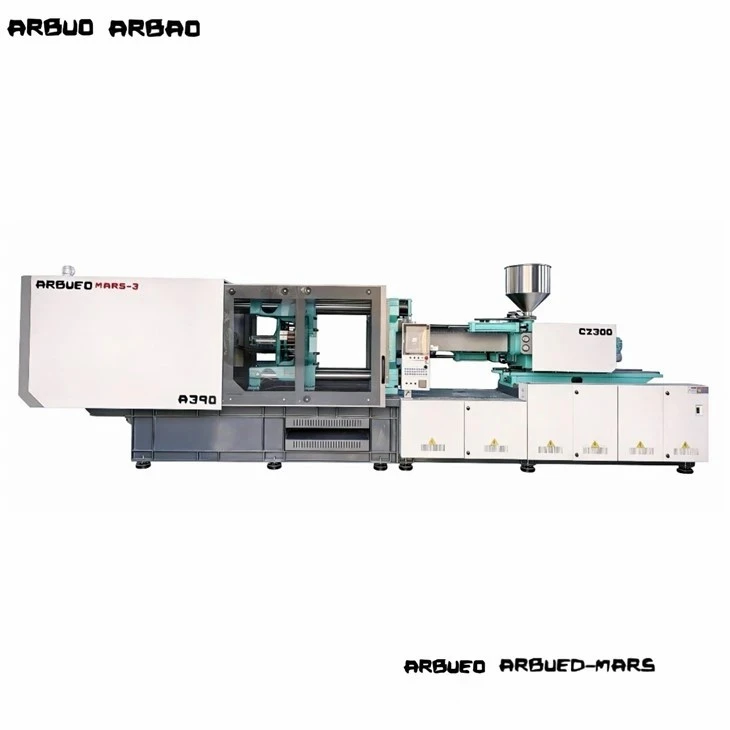
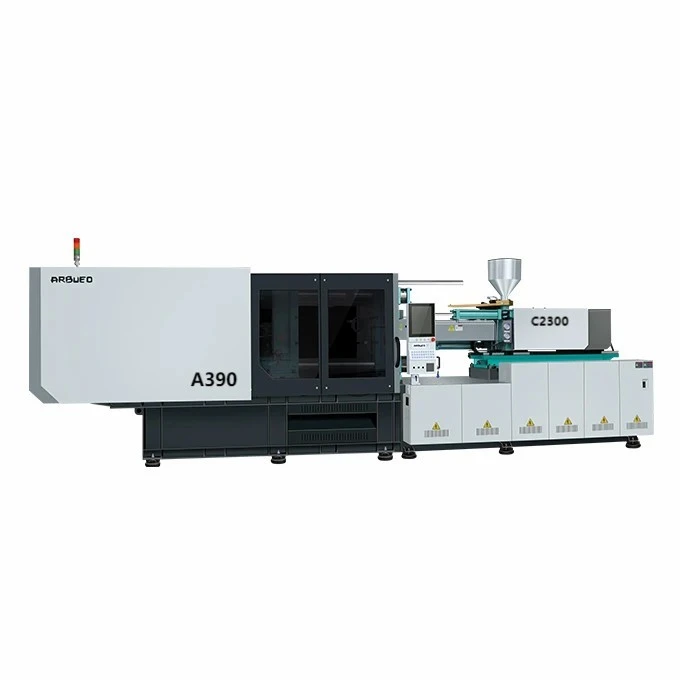

Hybrid Hydraulic-Electric Injection Molding Machine
Hybrid hydraulic-electric injection molding machines combine servo-electric injection units with hydraulic clamping systems. This architecture targets high-speed, high-tonnage molding operations requiring tight dimensional tolerances and reduced power consumption.
The electric drive executes continuous meter-in/meter-out dosing and high-response plasticizing, independent of the hydraulic circuit. The hydraulic system manages high-force clamping, core pulling, and ejector sequences using a variable-displacement servo pump. Separating mechanical plasticizing from hydraulic clamping eliminates hydraulic fluid shear heating during screw rotation, cutting power usage by 30% to 50% compared to conventional fixed-displacement hydraulic machinery.
Architecture Summary:
Servo-Electric Injection Subsystem: Dedicated to precise screw rotation, dosing, independent parallel motion during clamp movement, and closed-loop servo response.
Hydraulic Clamping Subsystem: Dedicated to toggle or direct hydraulic clamping, high clamping force generation, core pulling, and ejector sequences.
Technical Comparison: Drive Technologies
The following table details performance and financial trade-offs between machine drive formats to assist in machine platform selection:
|
Metric / Feature |
Hydraulic Machine |
Hybrid Machine |
All-Electric Machine |
|
Initial Capital Investment |
Baseline (1.0x) |
Mid-Range (1.2x - 1.35x) |
High (1.6x - 2.0x) |
|
Energy Consumption |
High baseline |
30% - 50% Savings |
50% - 70% Savings |
|
Injection Position Precision |
+/- 0.05 mm |
+/- 0.01 mm |
+/- 0.005 mm |
|
Parallel Motion Capability |
Limited (requires multi-pump) |
Standard (dosing during movement) |
Standard |
|
Clamping Force Range |
Unlimited (50 to 4,000+ Ton) |
Medium to High (100 to 1,500+ Ton) |
Limited High-Tonnage Options |
|
Hydraulic Core Pull Integration |
Native |
Native |
Requires Add-on Power Unit |
|
Oil Change Interval |
4,000 Hours |
10,000 Hours |
N/A (Grease Lubrication) |
|
Cleanroom Suitability |
Low (oil mist risk) |
High (enclosed injection zone) |
Highest |
Key Specifications
Below are standard technical ratings across key machine tonnages:
|
Specification |
Unit |
160 Ton |
280 Ton |
450 Ton |
650 Ton |
|
Clamping Force |
kN |
1,600 |
2,800 |
4,500 |
6,500 |
|
Tie Bar Clearance (H x V) |
mm |
470 x 470 |
620 x 620 |
820 x 820 |
980 x 920 |
|
Platen Dimensions (H x V) |
mm |
700 x 700 |
910 x 910 |
1,180 x 1,180 |
1,400 x 1,340 |
|
Max. Mold Opening Stroke |
mm |
450 |
580 |
780 |
920 |
|
Max. Daylight |
mm |
950 |
1,230 |
1,580 |
1,820 |
|
Screw Diameter (B-Screw) |
mm |
45 |
55 |
70 |
85 |
|
Theoretical Shot Volume |
cm3 |
318 |
605 |
1,385 |
2,438 |
|
Injection Weight (PS) |
g |
290 |
551 |
1,260 |
2,218 |
|
Max. Injection Pressure |
bar |
2,150 |
2,020 |
1,850 |
1,750 |
|
Injection Speed |
mm/s |
200 - 350 |
200 - 300 |
160 - 250 |
140 - 220 |
|
Plasticizing Rate (PS) |
g/s |
32 |
58 |
110 |
165 |
|
Ejector Stroke / Force |
mm / kN |
140 / 48 |
170 / 77 |
200 / 110 |
250 / 160 |
|
System Operating Pressure |
bar |
160 |
160 |
175 |
175 |
Key Features
Parallel Motion Execution: Dosing occurs simultaneously with clamp opening and ejection, cutting overall dry cycle times by 1.2 to 2.5 seconds per shot.
Closed-Loop Pressure Control: Pressure transducers mounted directly behind the injection nozzle track cavity pressure at 1 ms sampling intervals to prevent flash and short shots.
Energy-Optimized Hydraulic Circuit: Double-swashplate variable servo pumps supply fluid only on demand during clamping or core actuation, keeping idle power draw below 0.8 kW.
Low Oil Temperature Operation: Decoupled plasticizing prevents heat transfer into the hydraulic reservoir. Average oil operating temperatures stay between 38 deg C and 42 deg C without heavy chiller load.
Linear Guide Carriage Support: Twin linear motion guides support the injection unit, maintaining barrel alignment within +/- 0.02 mm during high-speed forward and backward movements.
Machine Configuration
System Power & Fluid Routing
Injection Drive Line: The AC Servo Motor powers the gearbox, driving screw rotation for precise dosing directly into the heated barrel.
Hydraulic Power Unit: The servo pump feeds fluid through the central valve manifold. Hydraulic power is dynamically routed to both the injection unit (for axial movement and injection boost) and the clamping unit (for hydraulic cylinders and toggle clamping mechanics).
Injection Unit Architecture
Dosing Drive: Synchronous AC servo motor with water-cooled jackets connected via high-torque planetary gearbox.
Injection Actuation: High-response proportional hydraulic valve backed by twin accumulator banks for rapid injection velocity profiles.
Barrel & Screw: Nitrided steel construction (38CrMoAlA) hardened to 950 HV, with optional bimetallic layers (tungsten carbide alloy) for abrasive filled materials.
Clamping Unit Architecture
Mechanism: 5-point double toggle system with cast steel platens (QT500-7).
Tie Bars: High-tensile alloy steel (40Cr) with hard chrome plating (0.03 to 0.05 mm thickness) to minimize wear on guide bushings.
Lubrication: Automatic central grease pump featuring pressure-monitored distribution lines.
Product-Specific Technical Advantages
Repeatability and Shot-Weight Consistency
Direct servo control over screw displacement yields dosing positional accuracy within +/- 0.01 mm. Shot-weight variance remains under 0.15% across continuous 24-hour production runs on thin-wall polypropylene parts (compared to typical conventional hydraulic variance of up to 0.45%).
Hydraulic System Longevity
Decoupling the dosing process lowers thermal stress on the hydraulic fluid. Oil viscosity remains stable over longer intervals, extending fluid replacement cycles from 4,000 operational hours to over 10,000 hours. Component wear on pump vanes, seals, and proportional valves drops accordingly.
Footprint and Utility Savings
Combining electric injection efficiency with compact hydraulic clamping reduces total machine length by 12% to 18% compared to equivalent full-hydraulic models. Reduced oil volumes mean smaller cooling tower capacities are required on the factory floor.
Typical Applications
Automotive Components
Door handle mechanisms, HVAC ducting, connector housings, dash bezels, and under-hood fuse boxes.
Fits tight dimensional requirements for press-fit snap assemblies.
Medical & Precision Packaging
Syringe barrels, blood collection tube caps, thin-wall food containers, and flip-top closures.
Supports cleanroom Class 8 placement due to reduced hydraulic piping near the mold zone.
Industrial & Electrical Equipment
Terminal blocks, circuit breaker casings, switch plates, pump impellers, and power tool housings.
Capable of handling high structural load demands and thick-wall molding cycles without sink marks.
Material Compatibility
Unfilled Resins (PP, PE, PS, ABS): Processed using standard nitrided screws to ensure uniform melt homogeny at high throughput rates.
Engineering Polymers (PC, POM, PBT, PA6/PA66): Handled via high-torque electric drives to prevent resin degradation during plasticizing while accommodating high-viscosity melts.
Highly Filled & Abrasive Materials (PA66 + 30-50% Glass Fiber, PPS + Glass/Mineral): Outfitted with optional bimetallic barrel liners (iron-based or nickel-based alloys) and fully hardened tool steel screws to resist abrasive wear and corrosive off-gassing.
Configuration Options
Machine configurations are chosen based on the following part design and production criteria:
Thin-Wall & Fast Cycle Applications: Select High-Speed Accumulator Packs combined with Barrier Screw geometry.
Abrasive & Glass-Filled Polymers: Select Bimetallic Barrels paired with Carbide-Coated Screw Tips.
Complex Insert Molding: Add auxiliary Hydraulic Core Pull Interfaces for complex mold mechanics.
Injection Performance Add-Ons
Accumulator Assistance: Nitrogen-charged hydraulic accumulators boost injection speeds up to 500 mm/s for thin-wall packaging applications (<0.5 mm wall thickness).
Screw Profiles: Barrier screws for polyolefins, mixing-head screws for masterbatch blending, or low-compression screws for shear-sensitive materials like PC and PVC.
Machine Interfaces & Automation
Core Pull Circuits: Up to 4 hydraulic core-pull valves controllable via the machine PLC for complex mold actions.
Euromap Interfaces: Standardized Euromap 63 or Euromap 73 interfaces for robot pick-and-place integration.
Hot Runner Controllers: Integrated 8 to 32-zone hot runner control modules built into the machine cabinet.
Manufacturing & Quality Control
Platen Machining: Castings undergo stress-relief annealing before machining on 5-axis CNC portal milling centers to ensure platen parallelism within 0.05 mm across the entire surface.
Hydraulic Assembly: Valve manifolds are assembled in a dust-filtered clean room. Every hydraulic circuit undergoes static pressure testing at 1.5 times operating pressure (240 bar) to check for leakage.
Alignment Checks: Laser alignment tools verify tie bar parallel tolerances and platen-to-injection-unit alignment during assembly.
Full-Load Testing: Every machine undergoes a 48-hour dry-cycle run followed by a 4-hour full-load mold test under maximum system pressure to verify thermal stability, electrical safety, and vibration levels.
Customization & OEM Support
Engineering & Customization Workflow:
Part Drawings & 3D Model Review -> Mold & Cycle Analysis -> Tailored Machine Configuration
Available customization services include:
Mechanical Modifications: Custom platen bolt patterns (SPI, EUROMAP, or JIS standards), extended daylight options for tall molds, custom screw length-to-diameter (L/D) ratios, and enlarged tie-bar spacing.
Electrical System Adaptations: Operating voltages configured for local grids (e.g., 480V 60Hz 3-Phase for North America, 400V 50Hz 3-Phase for Europe).
Software Localization: Controller interfaces available in English, Spanish, German, French, and Portuguese with custom data logging screens and tailored software sequences.
What Buyers Should Provide for a Quote
To receive an accurate technical quotation and machine sizing recommendation, provide the following parameters:
Part Details: 2D/3D drawings (.STEP or .IGES files), part weight (g), and maximum wall thickness (mm).
Material Specifications: Polymer grade, manufacturer, shrink rate, and percentage of additives/fillers (e.g., glass fiber %).
Mold Specifications: Mold dimensions (L x W x H), total weight, number of cavities, and hot runner requirements.
Production Requirements: Required cycle time, target hourly output, and automation requirements (robotics, conveyor systems).
Site Conditions: Plant supply voltage/frequency, ambient temperature profile, and available chilled water specs.
FAQ
Q: How does a hybrid machine compare to an all-electric injection molding machine in price and performance?
A: A hybrid machine costs roughly 20% to 30% less than an all-electric machine of equivalent clamp tonnage. It matches all-electric dosing precision and speed while providing higher hydraulic clamping force and economical core-pull integration for complex automotive or technical parts.
Q: What maintenance schedule is required for the hydraulic fluid?
A: Because plasticizing heat is separated from the oil tank, fluid working temperatures stay low. Under normal conditions (40 deg C operating temperature), replace the ISO VG 46 hydraulic fluid every 10,000 operational hours or after two years of continuous operation, alongside standard filter changes every 2,500 hours.
Q: Can this machine interface with my existing robotic unloaders?
A: Yes. Machines come standard with EUROMAP 67 robot interfaces (or optional EUROMAP 73). This allows plug-and-play signals for mold-open position, core position, ejector status, and safety interlocks with all standard 3-axis servo robots.
Q: What spare parts are recommended for international installations?
A: We recommend stocking a basic critical kit: a set of heating bands, thermocouples, proportional valve seals, high-pressure oil filters, solid-state relays, and a spare screw tip assembly (check ring, rear ring, and tip).
Hot Tags: hybrid hydraulic injection molding machine, China hybrid hydraulic injection molding machine manufacturers, suppliers, factory


