


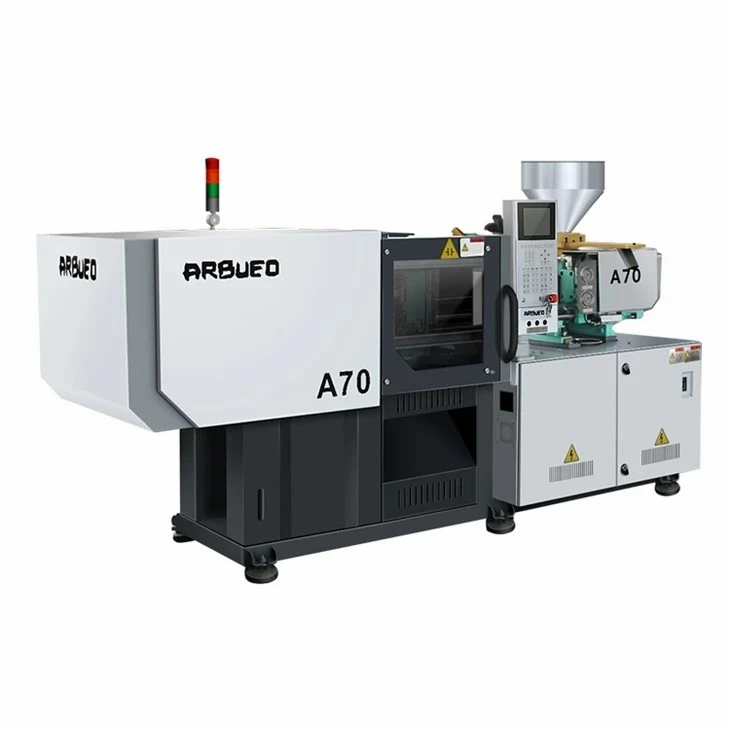
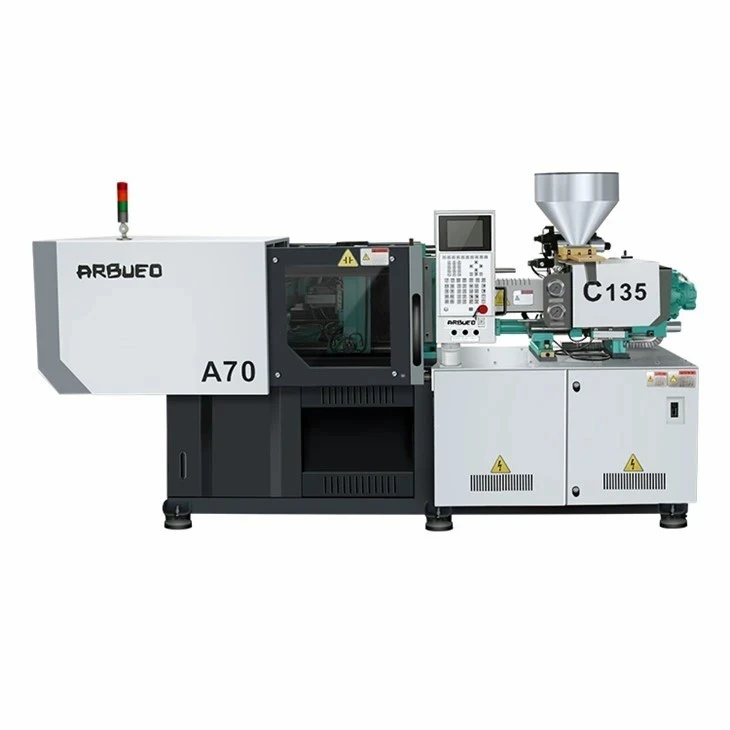
Servo Variable Pump Injection Molding Machine
This hydraulic injection molding machine integrates an axial variable displacement piston pump with a high-response permanent magnet synchronous servo motor. Designed for medium-to-heavy industrial plastic processing, the system dynamically adjusts hydraulic oil flow and pressure based on real-time load demand across injection, holding, cooling, and ejection phases.
By eliminating idling overflow losses inherent to fixed-displacement pump designs, the servo variable pump system reduces total electrical energy consumption by 30% to 55%. The closed-loop pressure and speed control response time is under 40 ms, ensuring stable hydraulic output during high-pressure holding stages and low-speed movements. Available in clamping force capacities ranging from 900 kN to 12,800 kN, this series caters to thin-wall packaging, automotive components, technical industrial fittings, and consumer durables.
System Operation & Architecture: The core system links a closed-loop controller directly to the servo motor and variable displacement pump assembly. This dynamic setup constantly regulates oil flow and pressure, delivering precise hydraulic energy directly to the actuators only when required by the cycle.
Key Specifications
|
Technical Parameter |
Metric Specification |
Imperial Specification |
|
Clamping Force Range |
900 - 12,800 kN |
101 - 1,438 US Tons |
|
Tie-Bar Distance (H x V) |
360x360 - 1,260x1,260 mm |
14.17x14.17 - 49.60x49.60 in |
|
Maximum Mold Daylight |
680 - 2,350 mm |
26.77 - 92.51 in |
|
Theoretical Shot Volume |
105 - 8,450 cm3 |
6.40 - 515.65 cu in |
|
Injection Weight (PS) |
96 - 7,690 g |
3.38 - 271.26 oz |
|
Injection Pressure (Max) |
1,650 - 2,350 bar |
23,931 - 34,083 psi |
|
Screw L/D Ratio |
20:1 - 24:1 (Standard) |
20:1 - 24:1 (Standard) |
|
Dry Cycle Time (Euromap) |
1.8 - 6.2 s |
1.8 - 6.2 s |
|
System Operating Pressure |
16 MPa (160 bar) |
2,320 psi |
|
Controller Interface |
Techmation / KEBA 10 in - 15 in Touchscreen |
Techmation / KEBA 10 in - 15 in Touchscreen |
Key Features
Dynamic Swashplate Adjustment: The displacement pump uses a swashplate mechanism linked to the servo driver. Swashplate angle changes match proportional flow demands instantly without excess heat generation.
Five-Point Double-Toggle Clamping: High-tensile cast iron platens driven by hardened steel toggle pins distribute clamping force evenly, preventing platen deflection and mold flash.
Nitride-Treated Bimetallic Screw & Barrel: Ion-nitrided carbon steel barrel with SACM 645 screw flight tipping ensures wear resistance against glass-fiber filled resins up to 30% loading.
Proportional Back-Pressure Control: Digital proportional valves adjust back-pressure dynamically during plasticizing, preventing melt voids and optimizing batch-to-batch density uniformity.
Linear Guide Rails on Injection Unit: Twin linear guide bearings support the injection unit carriage, eliminating tilting torques and preserving nozzle alignment under peak injection pressures.
Machine Configuration
The machine layout isolates mechanical load stresses while optimizing hydraulic path distances through three integrated core sections:
Hydraulic Power Pack (Central Drive): Integrates an axial piston variable pump mounted directly to a synchronous servo motor shaft. It supplies dynamic hydraulic pressure and oil flow to both the clamping unit and injection unit. An integrated oil cooler unit maintains fluid stability under cyclic operation.
Clamping Unit (Left Section): Features spherical graphite cast iron platens housing a five-point double-toggle linkage system driven by the central hydraulic pack. Includes an automatic lubrication system, and high-tensile tie bars treated with ultrasonic flaw detection and hard-chrome plating (0.03 to 0.05 mm thickness) to minimize guide bushing wear.
Injection Unit (Right Section): Powered symmetrically along the screw axis by dual-cylinder hydraulics. Equipped with twin linear guide rails to preserve nozzle alignment, a nitrided bimetallic screw and barrel assembly, and ceramic heater bands managed by PID loop controllers.
Control Architecture: An industrial PLC runs real-time fieldbus communications (CANbus/Ethernet) with microsecond response times for precise monitoring of temperature, position, and pressure across all units.
Product-Specific Technical Advantages
Energy Consumption Efficiency: Standard fixed pump machines operate at continuous maximum power output (100% consumption throughout the cycle). In contrast, the servo variable pump dynamically scales motor output and oil flow to real-time machine demand, using only 45% to 65% of full load power during operation and cutting overall electrical consumption by 35% to 55% per production cycle.
Reduced Thermal Load on Hydraulic Fluid: Because the pump alters displacement rather than bypassing pressurized oil back to the reservoir during hold and dwell cycles, oil temperature remains stable below 45 degrees C. Oil cooling water consumption decreases by up to 60%, and hydraulic oil lifespan doubles from 2,000 operational hours to 4,000+ hours.
Position Precision & Repeatability: Closed-loop linear optical transducers monitor clamping and injection movement. Mold opening and closing position accuracy reaches +/-0.1 mm, while injection transition repeatability to holding pressure stays within +/-0.05 mm.
Low Noise Emissions: Operating noise levels remain between 68 dB(A) and 73 dB(A) even during high-pressure injection phases, meeting European CE workplace noise guidelines without full acoustic enclosures.
Typical Applications
Automotive Interior & Exterior: Engine bay brackets, door panel clips, HVAC ducting, trim clips, and connector housings requiring high structural integrity and tight dimensional tolerances.
Industrial & Plumbing: Pipe couplings, valve bodies, electrical junction boxes, cable glands, and heavy-duty utility enclosures.
Household Products & Furniture: Structural furniture components, appliance chassis, crate handles, and storage bin lids requiring long hold times without thermal degradation.
Thin-Wall Packaging: Food containers, lids, and packaging caps produced on high-speed injection cycles using multi-cavity hot-runner molds.
Material Compatibility
|
Resin Type |
Material Characteristics |
Machine Processing Requirements |
|
PP / PE |
High shrinkage, low viscosity |
High injection speed capability, stable cooling pressure control |
|
ABS / PS |
Amorphous, prone to sink marks |
Accurate holding pressure response to eliminate internal voids |
|
PA6 / PA66 (Unfilled) |
Hygroscopic, low melt strength |
Decompression (suck-back) control, insulated nozzle heating zones |
|
PA66 + 30% GF |
Highly abrasive, fiber-filled |
Bimetallic screw flight tipping, hardened barrel lining |
|
PC / PMMA |
High melt viscosity, optical clear |
High-torque hydraulic motor, precision barrel temperature control (+/-1 degree C) |
Configuration Options
High-Torque Hydraulic Motors: Recommended for high-viscosity resins like PC, PBT, and thick-wall POM components requiring elevated plasticizing torque.
Corrosion-Resistant Electroplated Screw Sets: Specially designed for PVC, Flame-Retardant ABS, or CPVC applications to prevent chemical erosion of metal surfaces.
Accumulator-Assisted Injection: Nitrogen accumulators can be integrated for high-velocity thin-wall injection applications exceeding 300 mm/s.
Core Puller Units: Single, double, or multi-circuit hydraulic core pull interfaces programmable directly through the main PLC screen.
Air Injection Valves: Pneumatic ejector valves for blown-part ejection or complex mold release mechanisms.
Manufacturing & Quality Control
Casting Integrity: Machine bases are fabricated from stress-relieved Q235B structural steel, annealed at 600 degrees C to eliminate internal welding stress prior to machining.
Precision Machining: Platens, slide beds, and toggle links undergo single-setup machining on 5-axis horizontal CNC machining centers to ensure parallel tolerances within 0.05 mm per meter.
Quality Verification & Inspection Protocol:
Coordinate Measuring Machine (CMM) checks for tie-bar parallelism, platen squareness, and hole center distances.
Ultrasonic Non-Destructive Testing (NDT) verifies tie-bar material density and detects internal cracks or inclusions.
24-Hour Dry-Run Testing: Every unit undergoes a continuous 24-hour dry-cycling test to check hydraulic heat rise, electrical loop continuity, and lubrication flow.
Full Load Pressure Holding Verification: Hydrostatic testing on all manifold blocks and valves up to 21 MPa prior to machine assembly.
Customization & OEM Support
Platen Dimensions & Daylight Extensions: Custom platen dimensions, extended tie-bar clear distances, or enlarged mold daylight distances to accommodate deep-draw molds or thick core-pulling molds.
Custom Screw Geometry: Specific screw designs including barrier screws, mixing pins, and specialized L/D ratios (up to 26:1) tailored to masterbatch dispersion or shear-sensitive resins.
Interface Compatibility: Integration of Euromap 12 or Euromap 63 robot interfaces, SPI protocols, and standardized auxiliary power sockets (16A / 32A) matching regional electrical standards (208V / 230V / 400V / 480V at 50 / 60 Hz).
What Buyers Should Provide for a Quote
To receive an accurate technical quotation and machine sizing calculation, provide the following production details:
Part Geometry & CAD Files: Part dimensions, wall thickness distribution, 3D file (.STEP / .IGES), or part weight (grams).
Resin Material Grade: Specific polymer type, filler percentage (e.g., PA66 + 30% GF), and melt flow index (MFI).
Mold Specifications: Mold dimensions (Length x Width x Height), weight, number of cavities, and hot runner design.
Target Output Requirements: Desired cycle time, required annual production volume, and robot automation needs.
Regional Electrical Requirements: Factory operating voltage, phase, and frequency (e.g., 400V, 3-Phase, 50 Hz).
FAQ
Q: What is the main difference between a fixed pump, variable pump, and servo variable pump machine?
A: A fixed pump delivers constant fluid volume regardless of demand, dumping excess fluid back to the tank through relief valves at full pressure, wasting substantial energy. A conventional variable pump adjusts displacement based on system pressure, reducing continuous hydraulic load. A servo variable pump combines an axial variable piston pump with a high-response dynamic servo motor; it matches both motor speed and pump displacement simultaneously to the exact real-time demand of the process step, offering maximum energy efficiency and accurate pressure control.
Q: How does the energy consumption of a servo variable pump compare to an all-electric machine?
A: All-electric machines are highly energy-efficient, but servo variable pump hydraulic machines achieve up to 80-90% of an all-electric machine's efficiency while providing significantly higher clamping force capabilities and lower total capital investment cost. They offer a highly cost-effective balance for medium-to-large tonnage applications.
Q: Can this machine handle engineering plastics like Polycarbonate (PC) or Nylon (PA66) with glass fiber?
A: Yes. For high-viscosity or glass-fiber filled materials, we configure the machine with bimetallic screw and barrel assemblies, specialized high-torque hydraulic drive motors, and reinforced heater bands. Standard NITRALLOY treatment is upgraded to a high-chromium / tungsten carbide alloy coating to prevent abrasive wear.
Q: What international safety and operational standards does the machine comply with?
A: Machines exported to international markets adhere to European CE safety directives (EN 201 safety standards for plastic machinery), featuring dual-circuit electrical safety doors, mechanical safety interlocks, and hydraulic pressure dump valves. Electrical cabinets comply with IEC standards and incorporate top-tier components (e.g., Schneider, Eaton, Siemens).
Q: What is the typical lead time and shipping preparation for overseas orders?
A: Standard tonnage models (900 kN to 4,000 kN) typically carry a manufacturing lead time of 30 to 40 days. Custom configurations or large-tonnage units (above 6,500 kN) take 50 to 70 days. Machines are wrapped in anti-rust protective films, mounted on steel skids, and secured inside standard container frames (40HQ or Open Top containers) for safe ocean transit.
Hot Tags: variable pump servo injection molding machine, China variable pump servo injection molding machine manufacturers, suppliers, factory


