


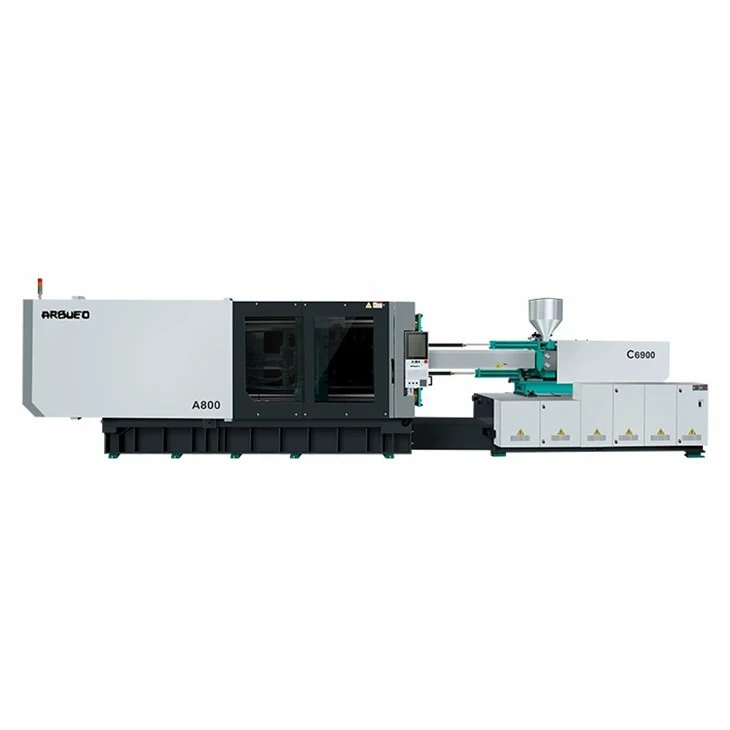
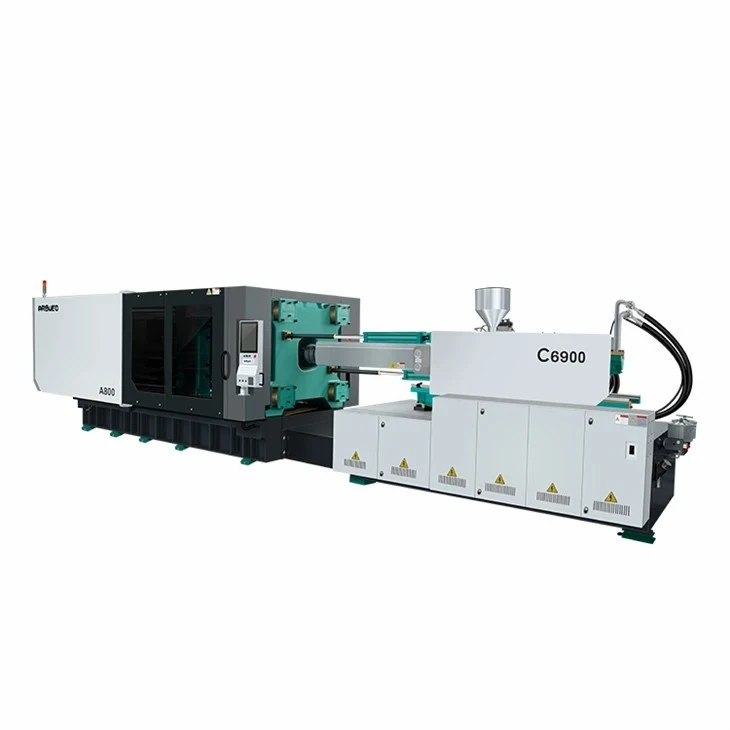
800-Ton Injection Molding Machine
The 800-ton horizontal hydraulic injection molding machine is engineered for heavy-duty, high-precision manufacturing of medium to large structural plastic components. Designed to balance structural rigidity with fast cycle dynamics, this unit features a heavy-duty five-point double-toggle clamping mechanism driven by a variable-displacement servo-hydraulic drive system.
It provides reliable clamping force distribution across large mold surface areas, preventing parting-line flash during high-pressure injection phases. Capable of handling shot weights ranging from 2,800 g to 4,200 g (PS equivalent), this machine serves Tier-1 automotive suppliers, industrial crate and pallet manufacturers, appliance OEMs, and municipal pipe fitting producers requiring continuous 24/7 duty cycles.
Key Specifications
The technical specifications below outline the standard operational parameters for the 800-ton platform.
|
Specification Parameter |
Value / Range |
Unit |
|
Clamping Force |
8,000 / 800 |
kN / Ton |
|
Toggle System Type |
5-Point Double Toggle |
- |
|
Distance Between Tie Bars (H x V) |
1,020 x 980 |
mm |
|
Platen Dimensions (H x V) |
1,480 x 1,440 |
mm |
|
Max. Mold Height |
1,050 |
mm |
|
Min. Mold Height |
400 |
mm |
|
Clamping Stroke |
1,000 |
mm |
|
Max. Open Daylight |
2,050 |
mm |
|
Hydraulic Ejector Force |
220 |
kN |
|
Hydraulic Ejector Stroke |
260 |
mm |
|
Screw Diameter Options |
A: 90 / B: 100 / C: 110 |
mm |
|
Theoretical Shot Volume (Screw B) |
3,140 |
cm³ |
|
Max. Injection Weight (PS, Screw B) |
2,850 |
g |
|
Injection Pressure (Screw B) |
175 |
MPa |
|
Max. Screw Speed |
0–140 |
rpm |
|
System Hydraulic Pressure |
17.5 |
MPa |
|
Servo Motor Power |
75 + 45 |
kW |
|
Heating Capacity |
42 |
kW |
|
Dry Cycle Time (Euromap 6) |
4.8 |
sec |
|
Machine Dimensions (L x W x H) |
10.8 x 2.4 x 2.7 |
m |
|
Total Machine Weight |
42,000 |
kg |
Key Features
High-Rigidity Box-Frame Platen Structure: Finite Element Analysis (FEA) optimized mold platens minimize center deflection under full tonnage, extending mold core/cavity tool life.
Dual-Pump Servo-Hydraulic Drive: Electro-hydraulic system utilizes double servo motors and gear pumps, lowering electrical consumption by 30% to 55% compared to conventional fixed-displacement systems.
Hardened Nitrided Screw & Barrel Assembly: SACM 645 / 38CrMoAlA alloy construction with plasma nitriding treatment (hardness >= 950 HV, depth 0.5–0.8 mm) resists mechanical wear and chemical corrosion.
Closed-Loop PID Temperature Modules: Multi-zone ceramic heater bands managed via solid-state relays achieve thermal stability within +-1°C across the barrel length.
Linear Guide Support for Injection Unit: Linear motion guide rails support the injection sled, maintaining precise nozzle centering and eliminating platen tilt during plasticizing.
Proportional Valve Hydraulic Control: Dynamic regulation of system flow and pressure profiles during high-speed cavity filling and holding transitions.
Working Principle / Machine Configuration
The operational sequence follows a closed-loop hydraulic process governed by a dedicated PLC controller:
Core Subsystems Configuration
|
Subsystem |
Technical Configuration |
|
Clamping Unit |
• Cast-steel platens (QT500-7) • Chromed 40Cr steel tie bars (180 mm dia.) • Centralized automatic lubrication pump |
|
Injection Unit |
• Twin pull-cylinder balanced injection • Cold-start screw protection interlock • Linear displacement transducers (0.01 mm resolution) |
|
Hydraulic Power Unit |
• Phase / Inovance servo drives • Sumitomo / Eckerle internal gear pumps • Yuken / Rexroth proportional valves |
|
Electrical Control |
• Techmation / KEBA 10-inch color touchscreen • SSR heater control + Omron relays • Euromap 67 robot interface port |
Product-Specific Technical Advantages
Structural Deflection Control
Platen bending under 800-ton loads causes wall thickness variation and flash along outer parting lines. The box-shaped platen design uses internal stress-ribbing verified by FEA software. Platen deflection under maximum clamping tonnage remains under 0.08 mm, preserving tight part tolerances and reducing mold wearing.
Precise Injection Position Control
Equipped with optical linear encoders accurate to 0.01 mm, the injection unit executes V/P (Velocity-to-Pressure) switching based on exact screw positions rather than timer delays. This prevents over-packing or sink marks in multi-cavity large structural parts.
Servo System Thermal Efficiency
The variable-speed servo motors run only at the RPM required by each cycle phase. During cooling steps, motor output drops to zero, reducing hydraulic oil heating. This maintains hydraulic oil temperatures between 35°C and 45°C using smaller shell-and-tube heat exchangers, reducing cooling water supply requirements by up to 40%.
Typical Applications
Automotive Parts
Exterior & Interior Components: Front/rear bumper fascias, door trim panels, instrument panel structural frames, and wheel arch liners.
Under-the-Hood Components: Engine covers, air intake manifolds, and battery tray enclosures.
Industrial Logistics Packaging
Heavy Packaging: Collapsible plastic shipping crates, stackable logistics totes, heavy-duty industrial pallets, and 20L chemical drums/buckets.
Home Appliances & Consumer Durables
Structural Housings: Washing machine outer tubs, air conditioner outdoor unit chassis, television rear covers, and vacuum cleaner bodies.
Building & Infrastructure
Utility Fittings: Large-diameter PVC/PPR/PE pipe fittings (couplings, tees, 90° elbows up to 400 mm diameter), electrical junction boxes, and drainage inspection chambers.
Material Compatibility
The 800-ton machine supports commodity thermoplastics, engineering resins, and filled compounds:
|
Material Classification |
Supported Polymer Types |
|
Commodity Polymers |
Polypropylene (PP), High-Density Polyethylene (HDPE), Polystyrene (GPPS/HIPS), Rigid PVC |
|
Engineering Polymers |
Polycarbonate (PC), ABS / PC-ABS Blends, Polyamide 6/66 (Nylon), Polyoxymethylene (POM) |
|
Filled & Blended Resins |
10%–40% Glass-Filled Polyamides (PA6/PA66), Talc-Filled PP, Flame-Retardant ABS |
Standard Screw (L/D 20:1 to 22:1): Suitable for general-purpose PP, PE, PS, and ABS processing.
Bimetallic Barrel & Screw Option: Recommended when processing glass-fiber reinforced polymers (>= 30% GF) to resist abrasive wear.
Upgraded Drive Motor & Heater Option: Recommended for engineering polymers with high melting temperatures (e.g., PC, PA66) requiring processing temperatures up to 380°C.
How to Select / Configuration Options
Selecting the standard screw setup depends on part surface area, wall thickness, shot weight, and resin flow characteristics (MFR):
|
Selection Parameter |
Option A (90 mm) |
Option B (100 mm) |
Option C (110 mm) |
|
Theoretical Shot Volume |
2,540 cm³ |
3,140 cm³ |
3,800 cm³ |
|
Max. Shot Weight (PS) |
2,310 g |
2,850 g |
3,450 g |
|
Specific Injection Pressure |
210 MPa |
175 MPa |
145 MPa |
|
Primary Application |
High-pressure thin-wall parts, PC/ABS components |
General structural molding, automotive panels, crates |
Thick-wall or high-volume parts (HDPE buckets) |
Configurable Machine Features
Core Pulling Units: 2-to-4-circuit hydraulic core pullers for complex molds with moving side-action slides.
Sequential Valve Gating: 4-to-8-zone pneumatic/hydraulic valve gate controllers for runnerless hot runner molds.
Air Injection Valves: Integrated air blast valves on movable and fixed platens for part ejection assistance.
Specialized Screws: Unmixing screws for masterbatch blending, low-shear screws for rigid PVC, or corrosion-resistant plated screws for flame-retardant polymers.
Manufacturing & Quality Control
Every 800-ton injection molding machine undergoes rigorous assembly and verification steps before factory dispatch:
[Platen Machining on CNC Boring Mills]
↓
[Tie Bar Ultrasonic Flaw Detection (UT)]
↓
[Mechanical & Hydraulic Line Assembly]
↓
[Laser Interferometer Alignment Checks]
↓
[100% Load & 24-Hour Dry Run Testing]
Machine Testing Protocol
Parallelism & Squareness Verification: Laser interferometers measure platen parallelism across four quadrants under zero and full load conditions, keeping deviation within <= 0.05 mm/m.
Pressure Hold & Leak Testing: Hydraulic manifolds undergo static pressure testing at 21 MPa (120% rated system pressure) for 4 hours to verify seal integrity.
Dry Cycle Endurance: Machines perform a continuous 24-hour dry-cycle factory run under full operational speed to confirm electrical system stability and thermal performance.
Customization & OEM Support
To support specific production cell configurations, the following custom engineering modifications are available:
Extended Platen & Daylight Options: Extended tie-bar lengths and daylight openings for unusually tall, deep-draw molds (e.g., trash cans or tall containers).
Robotic Interface Automation: Factory-installed Euromap 67 or Euromap 12 standard plug connections for integration with 3-axis servo side-entry or top-entry robots.
Custom Color Schemes: Industrial polyurethane paint finishes applied according to client-specified RAL color codes.
Power Grid Adaptation: Transformers provided for standard regional industrial power supply requirements:
North America: 460V / 3P / 60Hz or 575V / 3P / 60Hz
Europe / Asia / South America: 380V / 3P / 50Hz or 415V / 3P / 50Hz
What Buyers Should Provide for a Quote
Providing the following specifications helps our application engineering team evaluate your requirements, verify machine sizing, and supply an accurate quotation:
|
Information Category |
Details Required |
|
Plastic Part Details |
• Part dimensions (L x W x H) and wall thickness • Part weight (grams or kilograms) • 3D STEP model file or 2D technical drawings |
|
Material Properties |
• Polymer grade (e.g., HDPE, PP, PC/ABS, PA66+30%GF) • Density (g/cm³) and Melt Flow Index (MFI/MFR) |
|
Mold Tool Dimensions |
• Mold base dimensions (Width x Height x Depth) • Total weight of mold tool • Number of cavities (1, 2, 4, etc.) • Runner system type (Cold runner or Hot runner) |
|
Operational Needs |
• Target cycle time requirement • Hydraulic core pull requirements (number of circuits) • Local industrial electrical voltage and frequency |
fAQ
Q: What is the maximum mold size that can fit on this 800-ton machine?
A: The clear distance between tie bars is 1,020 mm x 980 mm. Molds can be loaded horizontally or vertically. If a mold exceeds these tie-bar dimensions, one dimension must remain under 1,010 mm to allow installation through the side tie bars. The maximum allowable mold base size mounted directly on the platen faces is 1,480 mm x 1,440 mm, with total mold weight capped at 12,000 kg.
Q: How do I determine if 800 tons of clamping force is sufficient for my part?
A: Clamping force depends on the total projected area of the part (and runner system) multiplied by the required cavity pressure for your resin type. Commodity materials like PP and PE usually require 0.3 to 0.5 tons per square centimeter (2 to 3.5 tons/in²), while engineering plastics like PC or PA require 0.6 to 0.9 tons per square centimeter (4 to 6 tons/in²).
Formula:
Required Clamping Force (Tons) = Projected Area (cm²) x Material Cavity Factor (Tons/cm²)
Q: What is the typical energy consumption under real operating conditions?
A: While the total installed motor power is 120 kW (75 kW + 45 kW dual servo motors), real power draw depends on the cycle phase. Because servo motors slow down or stop during cooling and holding phases, average operational power consumption typically stays between 40 kW/h and 58 kW/h when running standard PP or PE industrial parts.
Q: What maintenance schedule should be followed for high-tonnage operation?
A: Daily: Check oil levels in the central reservoir, inspect automatic lube grease pressure on the toggle joints, and confirm heat exchanger cooling water flow.
Monthly: Clean hydraulic oil suction filters, check tie-bar nut tightness, and inspect all safety door interlocks.
Every 5,000 Hours / Annually: Replace return line hydraulic oil filters, perform oil contamination sampling (ISO 4406 target cleanliness: <= 18/16/13), and verify alignment of the platens and injection sled using optical measuring equipment.
Hot Tags: 800 ton injection molding machine, China 800 ton injection molding machine manufacturers, suppliers, factory


