


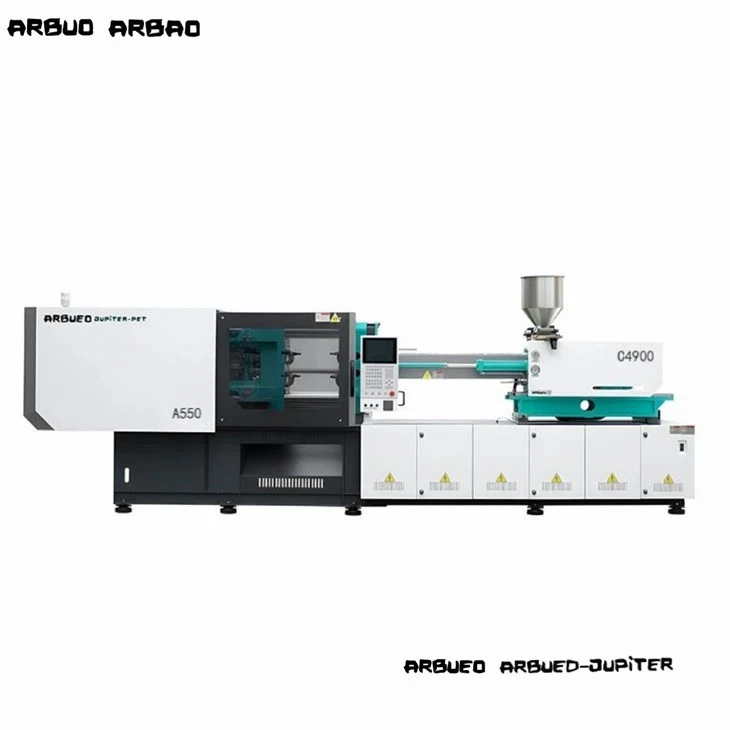
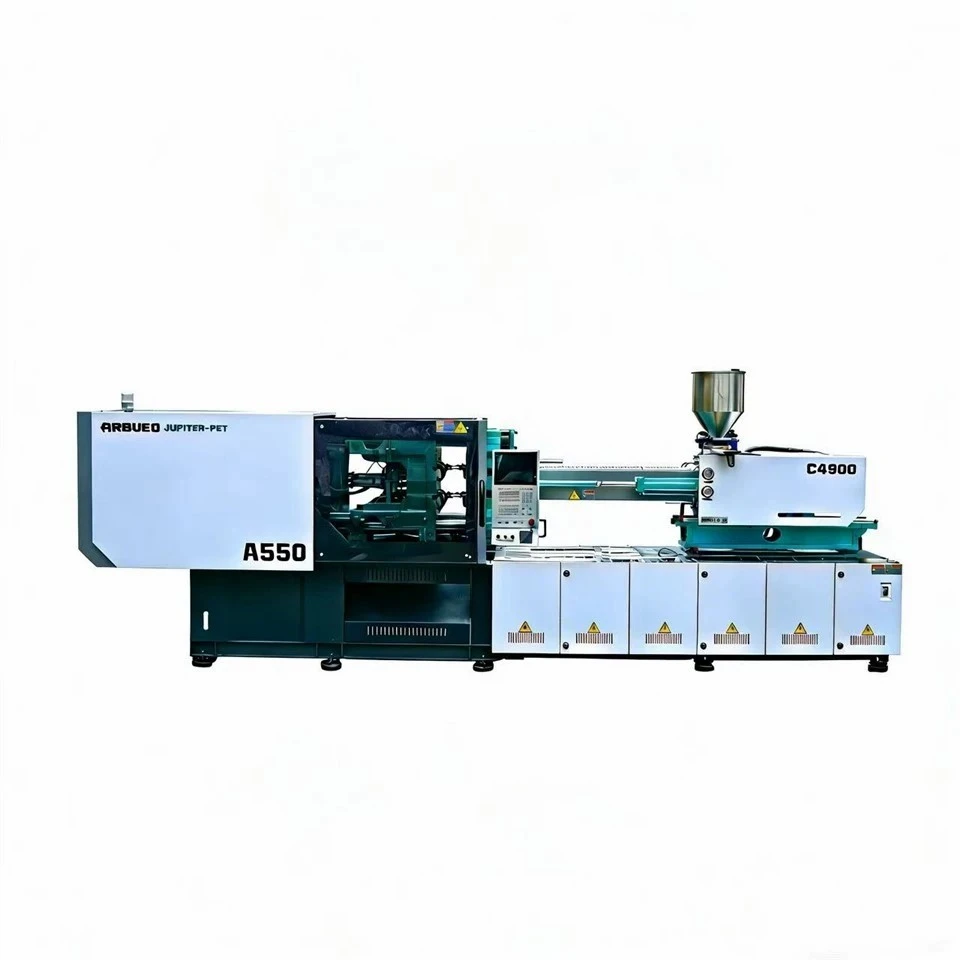
500 Ton Injection Molding Machine
The 500 Ton Servo-Hydraulic Injection Molding Machine is engineered for medium-to-large structural components requiring high clamping stability, consistent wall-thickness control, and fast cycle times. Built with an optimized 5-point double-toggle clamping system and a closed-loop servo-hydraulic drive, this machine balances energy efficiency with heavy-duty structural rigidity.
It is tailored for industrial molders producing automotive interior and exterior trims, heavy plastic crates, appliances, and industrial fluid fittings. Operating with dynamic pressure response and precise position control, it reduces part distortion, internal stress, and flash during high-tonnage molding operations.
Key Specifications
|
Specification Category |
Metric Unit |
Technical Value / Standard Option |
|
Clamping Force |
kN / Ton |
5000 kN / 500 US Tons |
|
Distance Between Tie Bars (H x V) |
mm |
810 x 810 |
|
Platen Dimensions (H x V) |
mm |
1180 x 1180 |
|
Max. Daylight |
mm |
1660 |
|
Opening Stroke |
mm |
830 |
|
Mold Thickness (Min. - Max.) |
mm |
300 - 830 |
|
Ejector Stroke |
mm |
220 |
|
Ejector Force |
kN |
140 |
|
Screw Diameter Options |
mm |
75 / 80 / 85 |
|
Theoretical Injection Volume |
cm3 |
1590 / 1809 / 2042 |
|
Shot Weight (PS) |
g |
1447 / 1646 / 1858 |
|
Injection Pressure |
MPa |
205 / 180 / 160 |
|
Injection Rate (PS) |
g/s |
380 - 480 |
|
Screw L/D Ratio |
L/D |
22:1 (Standard) / 24:1 (High Mix) |
|
System Pressure |
MPa |
17.5 |
|
Servo Motor Power |
kW |
55 + 37 (Dual Servo Drive Options Available) |
|
Heating Power |
kW |
32 |
|
Machine Dimensions (L x W x H) |
m |
8.8 x 2.1 x 2.4 |
|
Machine Total Weight |
Ton |
approx. 24.5 |
Key Features
Absolute Encoder Servo System: Direct-drive permanent magnet servo motor with an internal gear pump delivers a response speed under 40 ms, eliminating bypass hydraulic throttling and reducing energy consumption by 30% to 60% compared to fixed-displacement systems.
Rigid Box-Structure Platens: Finite Element Analysis (FEA) designed nodular cast iron platens minimize center deflection under high tonnage, preserving mold parallelism and extending mold service life.
Linear Guide Rail Injection Mechanism: Dual-injection cylinders guided by precision linear motion rails maintain concentricity during high-speed plasticizing, preventing screw tilting and barrel wear.
Auto-Lubrication System: Programmable centralized lubrication distributes grease directly to toggle pins and bushings, monitored by pressure sensors to prevent premature mechanical wear.
Industrial Controller with Microsecond Sampling: Multi-CPU control platform supporting EUROMAP 63/74 robot interfaces, displaying real-time pressure curves, injection velocity profiles, and SPC process monitoring parameters.
Working Principle / Machine Configuration
The machine operates through four distinct phases controlled by real-time closed-loop feedback:
Clamping & Locking Phase: The high-torque hydraulic motor drives the 5-point toggle mechanism, moving the platen rapidly at low pressure. Once safety zones are clear, high-pressure clamping builds up to 5,000 kN, stretching the forged tie bars uniformly.
Plasticizing & Injection Phase: Solid polymer granules feed from the hopper into the heated barrel. The rotating screw melts and homogenizes the resin. Dual injection cylinders drive the screw forward, pushing molten plastic into the mold cavity at regulated pressure profiles (up to 205 MPa).
Holding Pressure & Cooling Phase: Hold pressure is held according to multi-stage settings to compensate for volumetric shrinkage as the part solidifies. Independent PID heating zones maintain tight thermal boundaries across all barrel sections.
Mold Opening & Ejection Phase: The moving platen retracts smoothly using proportional hydraulic deceleration curves. The integrated hydraulic ejector plate advances to actuate knockout pins, dropping or presenting parts for robotic automation.
Product-Specific Technical Advantages
Deflection Resistance Under Peak Tonnage: Heavy-section ductile iron platens restrict deflection under full 500-ton locking forces to less than 0.08 mm across the active platen faces, preventing core shift in deep-cavity molding.
Repeatable Injection Weight Precision: Microsecond-sampling digital pressure sensors combined with a high-response check valve guarantee shot weight consistency within +/-0.25%, drastically reducing scrap rates on critical dimensional components.
Hydraulic Fluid Longevity: Lower thermal dissipation in the closed-loop servo circuit keeps oil temperatures below 45 degrees C under continuous operations, preventing seal degradation, reducing oil oxidation, and lowering cooling water demand.
Tie-Bar Stress Uniformity: High-tensile 40Cr steel tie bars are surface-hardened via high-frequency quenching and finished with hard chrome plating. Automated ultrasonic testing ensures zero internal stress concentrations along thread roots.
Typical Applications
Automotive Exterior & Structural Parts: Bumper supports, wheel arch liners, door panels, and under-hood junction boxes requiring structural rigidity and high impact strength.
Logistics & Material Handling Containers: Heavy-duty stackable crates, component trays, and industrial storage bins with ribbing patterns.
Home Appliances & Consumer Goods: Washing machine outer tubs, air conditioner main frames, vacuum cleaner housings, and TV backcovers.
Industrial Pipe & Fluid Fittings: Large-diameter PVC/PP pressure pipe couplings, valve housings, and drainage components requiring heavy core pulling routines.
Material Compatibility
The plasticizing unit supports a broad range of thermoplastic resins:
Standard Screw (A-Type / B-Type): Optimized for PP, PE, PS, and ABS with balanced shear and plasticizing throughput.
Corrosion-Resistant Bimetallic Screw & Barrel: Engineered for processing corrosive or halogenated resins like rigid PVC, Flame-Retardant ABS, or CPVC.
Wear-Resistant Ceramic-Coated Unit: Intended for abrasive materials containing up to 45% glass fiber (PA66+GF45) or mineral fillers, preserving flight geometry over long production cycles.
How to Select / Configuration Options
Screw Selection Guidelines
Type A Screw (Small Diameter - 75 mm): Maximizes injection pressure (up to 205 MPa). Recommended for thin-walled engineered parts, PC/ABS blends, or parts with long flow-length ratios.
Type B Screw (Standard - 80 mm): Balanced pressure and shot volume performance (1646 g PS). Suitable for general industrial parts, auto trim, and home appliances.
Type C Screw (Large Diameter - 85 mm): Maximizes shot weight (up to 1858 g PS). Best suited for thick-walled polyolefin parts (PP/HDPE crates, buckets) where flow resistance is low.
Machine Options & Auxiliary Interfaces
Core Pulling Systems: 2-circuit or 4-circuit hydraulic core pull sequences driven by proportional valves for complex molds.
Ejector Parallel Motion: Simultaneous ejection during mold opening to reduce total cycle times by 1.5 to 3.0 seconds per shot.
Insulation Jacket Package: Barrel ceramic insulation covers that cut thermal radiation losses, saving up to 15% in heater band electrical consumption.
Air Blow Valves: Dual programmable air blast valves for blowing flexible parts clear of core halves or assisting mold release.
Automation Standard EUROMAP 67: Plug-and-play interface for 3-axis or 5-axis servo robots for automated part pick-and-place operation.
Manufacturing & Quality Control
Every machine undergoes strict testing procedures in accordance with ISO 9001 quality management standards prior to factory release:
Raw Material Integrity: Tie bar billets and platen castings undergo ultrasonic flaw detection and heat-treatment normalization logs before machining.
Machining Accuracy: Platens are processed on high-precision floor-type CNC boring mills. Tie-bar hole parallelism is held within 0.05 mm across diagonal axes.
Laser Interferometer Alignment: Machine beds and linear motion guides are aligned using laser interferometry to ensure linear repeatability and zero platen twist.
72-Hour Continuous Endurance Run: Every machine completes a 72-hour dry-cycle factory acceptance test, running full pressure cycles and dynamic temperature checks to verify hydraulic seal integrity and servo stability.
Customization & OEM Support
We provide tailored engineering adaptations to match specific tooling geometries and production lines:
Extended Mold Daylight & Stroke: Custom frame extensions and longer tie bars to accommodate deep-draw molds, hot runner stacks, or core-pull heavy tooling.
Specialized Barrel/Screw Geometries: Dedicated mixing heads, barrier screws, and anti-venting profiles designed for specific masterbatch dispersal or recycled regrind blends.
Custom Voltage Transformer Packages: Factory-installed power adaptation for global industrial grids (such as 208V/220V 3-Phase 60Hz for North America, 415V 50Hz for UK/Australia, or 380V 50Hz for Europe).
Color Scheme & Branding: Corporate paint matching and private-label machine covers for OEM distributors or contract manufacturing operations.
What Buyers Should Provide for a Quote
To receive an accurate technical quotation and machine sizing report, please submit the following project details:
Part Information: Part drawing/STEP file, target shot weight (grams or ounces), minimum and maximum wall thickness.
Resin Type & Grade: Polymer brand, melt flow index (MFI), density, and filler content (such as % Glass Fiber).
Mold Geometry: Mold dimensions (Width x Height x Thickness), total weight, number of cavities, and hot runner zones.
Target Output: Preferred cycle time and required daily output volume.
Site Requirements: Local operating voltage (V/Hz), ambient factory temperature, and available auxiliary automation (robots, chillers).
fAQ
Q: What is the typical energy saving compared to a conventional hydraulic machine?
A: The permanent magnet servo motor adjusts power consumption directly to output demands. During cooling phases, motor speed drops to near zero, resulting in energy savings between 30% and 60% compared to traditional fixed-displacement pump machines.
Q: What tie-bar clearance is needed for my mold?
A: This machine features an 810 mm x 810 mm clear space between tie bars. Molds with outer dimensions smaller than 800 mm in at least one direction can be loaded directly from the top or side.
Q: How do I choose between an 80 mm and an 85 mm screw?
A: Choose the 80 mm screw if your resin requires high injection pressure (such as PC or PA66+GF) or thin wall sections. Choose the 85 mm screw if you mold low-viscosity materials (such as PP or PE) and require maximum shot volume (up to 1858 g) to fill large parts.
Q: Does this machine comply with CE safety standards?
A: Yes. European export configurations include dual-circuit electrical safety interlocks, mechanical safety gates, hydraulic safety valves compliant with EN 201 safety regulations, and fully enclosed operator guarding.
Q: What maintenance is required for the hydraulic oil?
A: Because the servo system operates at lower temperatures than standard machines, oil oxidation is minimized. We recommend replacing hydraulic oil filters every 3,000 operational hours and conducting oil sampling annually to monitor viscosity and particulate levels.
Hot Tags: 500 ton injection molding machine, China 500 ton injection molding machine manufacturers, suppliers, factory


