


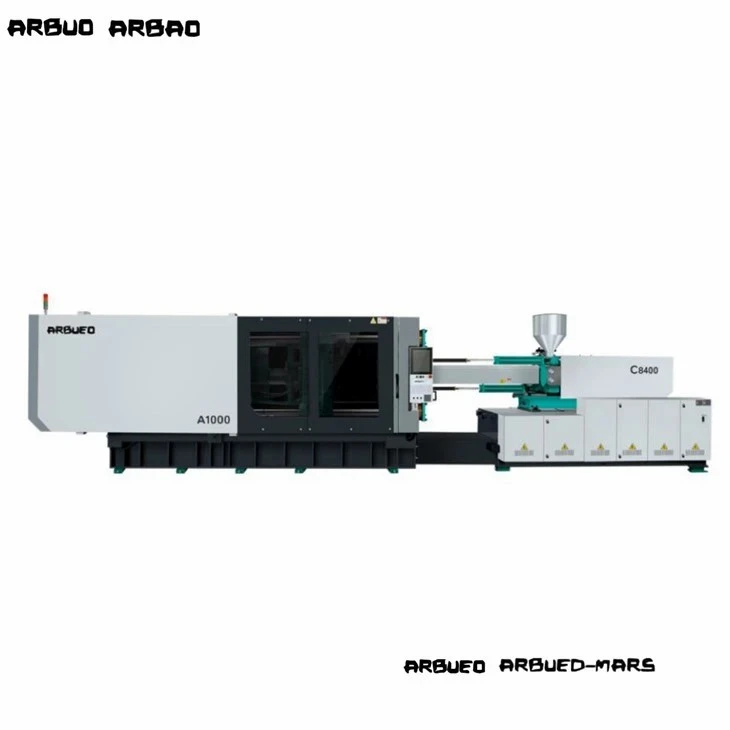
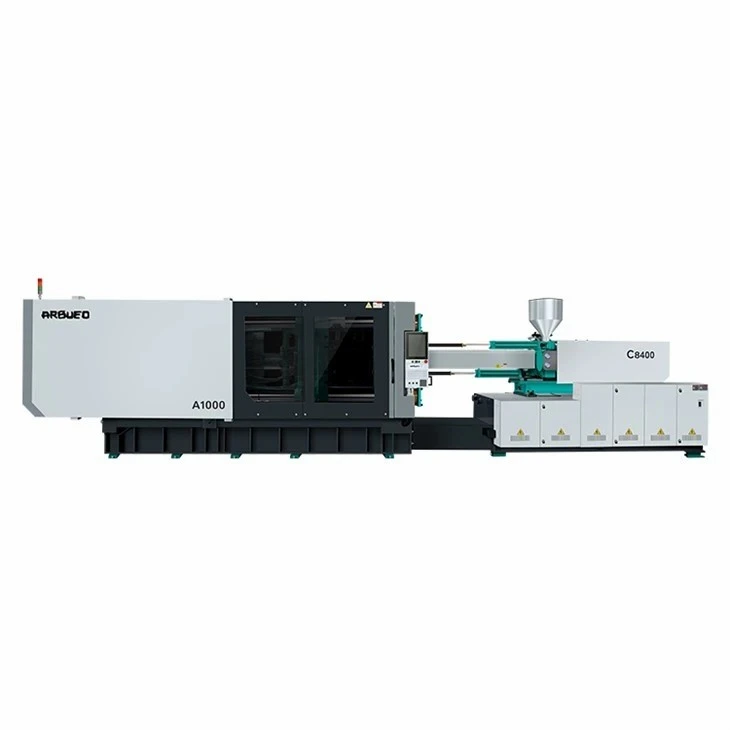
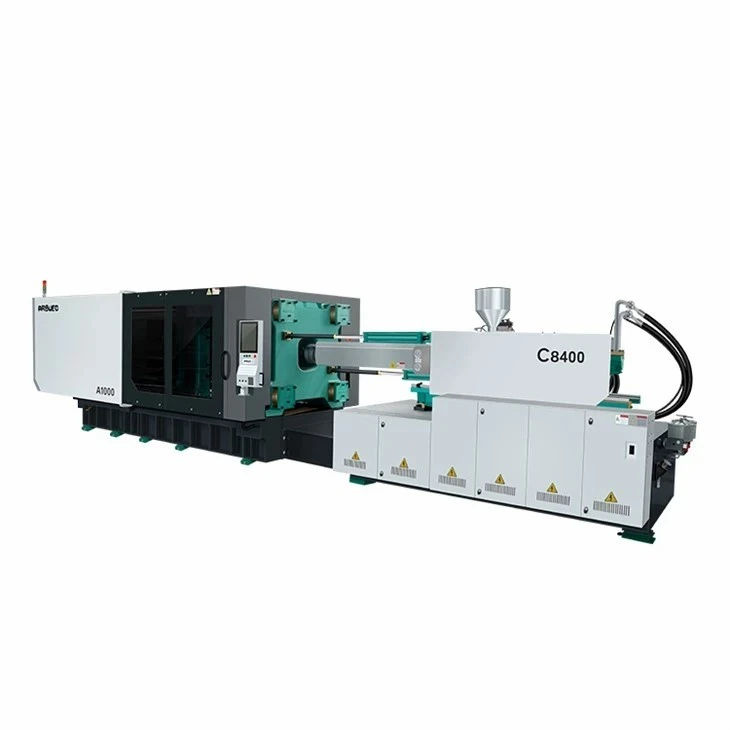
1000 Ton Injection Molding Machine
The 1000-ton hydraulic injection molding machine provides heavy-duty clamping force for large-scale industrial and automotive component manufacturing. Built for high-rigidity molding requirements, this machine handles deep-draw parts, thick-walled products, and multi-cavity structural components weighing up to 5,500 grams per shot.
It integrates a high-response servo-hydraulic system, heavy-duty platen design, and a multi-stage injection controller. This configuration minimizes platen deflection under maximum clamping pressure, ensuring tight dimensional tolerances across large surface areas.
Key Specifications
|
Specification Parameter |
Value / Unit |
|
Clamping Force |
10,000 kN (1,000 Ton) |
|
Toggle Stroke / Opening Stroke |
1,150 mm |
|
Distance Between Tie Bars (H x V) |
1,160 x 1,080 mm |
|
Platen Dimensions (H x V) |
1,650 x 1,570 mm |
|
Mold Thickness Range (Min - Max) |
450 mm - 1,150 mm |
|
Maximum Hydraulic Ejector Force |
220 kN |
|
Ejector Stroke |
300 mm |
|
Screw Diameter Options (A / B / C) |
105 mm / 115 mm / 125 mm |
|
Theoretical Shot Volume (B Screw) |
5,220 cm³ |
|
Max Shot Weight (PS) (B Screw) |
4,750 g |
|
Injection Pressure (B Screw) |
162 MPa |
|
Max Injection Speed |
110 mm/s |
|
Screw L/D Ratio (B Screw) |
22:1 |
|
Max Screw Rotation Speed |
135 rpm |
|
Servo Motor Power Rating |
95 kW |
|
Heating Capacity |
48.5 kW |
|
Hydraulic Tank Capacity |
1,200 L |
|
Machine Dimensions (L x W x H) |
11.8 m x 2.4 m x 2.8 m |
|
Total Machine Weight |
48,000 kg |
Key Features
Box-Type Platen Design: Finite Element Analysis (FEA) optimized ductile iron platens evenly distribute clamping force across the mold face, reducing flash formation and mold wear.
Five-Point Twin-Toggle Clamping Mechanism: Delivers fast mold movement cycles with mechanical locking rigidity at peak tonnage.
Variable-Frequency Servo Drive System: Matches hydraulic output directly to machine phase requirements, reducing energy consumption by 30% to 50% compared to fixed-displacement pumps.
Hardened Nitrided Screw & Barrel: Bimetallic treatment extends wear resistance when processing glass-fiber reinforced polymers (up to 30% GF).
Multi-Zone PID Temperature Control: Ceramic heating bands maintain barrel zone accuracy within +/-1 degree C.
Linear Guide Rails on Injection Unit: Reduces friction during carriage movement, improving injection repeatability and nozzle alignment precision.
Working Principle / Machine Configuration
The machine operates on a hydro-mechanical clamping cycle paired with a reciprocating screw injection unit:
Mold Closure & Locking: The servo motor drives a high-pressure gear pump to actuate the double-toggle mechanism. The toggles extend to lock the movable platen against the tie bars, generating 1,000 tons of mechanical clamping force.
Plasticization & Metering: The hydraulic motor rotates the screw to convey, melt, and shear raw polymer granules through the heated barrel. Backpressure is regulated via a proportional valve to ensure melt density uniformity.
Injection & Packing: Dual injection cylinders push the screw forward, driving molten plastic into the mold cavity at pressures up to 180 MPa. The controller switches from velocity to pressure control (V/P switchover) based on position, pressure, or time.
Cooling & Mold Opening: As the part cools inside the temperature-regulated mold cavity, the screw rotates to prepare the next plastic shot. The clamping cylinder retracts the toggle system with multi-stage speed profiles to prevent part shock during ejection.
Ejection: Hydraulic core pulls retract, and the central ejector pin array pushes the finished part clear of the core side.
Product-Specific Technical Advantages
Platen Rigidity & Mold Protection
Platen deformation under 1,000 tons of clamping pressure causes uneven wall thickness and parting-line flash. The box-structure platen maintains center-line deflection under 0.08 mm at maximum load. Low-pressure mold protection actively monitors platen position via digital encoders; if resistance is detected within 50 mm of mold touch, clamping halts within 15 milliseconds to prevent mold damage.
Injection Repeatability
The injection unit utilizes closed-loop proportional valve feedback for injection speed and pressure control. Screw position sensing via optical linear scales delivers shot-size precision within +/-0.1 mm, ensuring part weight variation remains below 0.25% across continuous 24-hour production runs.
Hydraulic System Stability
A bypass off-line oil filtration unit maintains hydraulic fluid cleanliness to NAS Class 8 standards. The water-cooled oil heat exchanger keeps operating oil temperatures between 35 degrees C and 50 degrees C, preserving seal integrity and preventing valve sticking during ambient summer spikes up to 45 degrees C.
Typical Applications
Front and rear bumper fascias
Interior door panels and dashboard sub-frames
Wheel arch liners and engine bay shrouds
Heavy-duty foldable plastic crates and pallets
50-Liter to 100-Liter waste bins and agricultural totes
Underground drainage inspection chambers
Washing machine tubs and outer casings
Air conditioner outdoor unit housings
Large PVC/PP pipe fittings and inspection junctions
Material Compatibility
This machine processes commodity, engineering, and reinforced thermoplastic resins:
Polypropylene (PP) & Polyethylene (HDPE/LDPE): Optimized for large packaging, crates, and thin-wall structural parts.
Acrylonitrile Butadiene Styrene (ABS) & PC/ABS Blends: Used for automotive interior trim and appliance housings requiring high surface finish quality.
Polyamide (PA6 / PA66 with up to 35% Glass Fiber): Requires the optional bimetallic barrel screw set to resist abrasive wear during technical component production.
Unplasticized Polyvinyl Chloride (U-PVC): Requires custom hard-chrome plated screw geometry and dedicated barrel fan cooling for thermal stability.
How to Select / Configuration Options
Screw Geometry Options
Standard A-Screw (105 mm): Higher injection pressure (up to 195 MPa); recommended for thin-wall molding or hard-to-flow resins (PC, PA).
Standard B-Screw (115 mm): Balanced pressure and volume ratio; suitable for general automotive and industrial parts.
Standard C-Screw (125 mm): Maximum shot volume (up to 5,500 g); ideal for polyolefin (PP/PE) thick-walled parts where lower injection pressure suffices.
Optional Modules
Hydraulic Core Pulling: Dual or quadruple directional control valves for complex molds with moving side cores.
Sequential Valve Gate (SVG) Controller: Integrated 4 to 8-zone pneumatic/hydraulic controller for hot runner systems to eliminate weld lines on large automotive parts.
Accumulator-Assisted High-Speed Injection: Nitrogen accumulators increase injection speed up to 300 mm/s for thin-wall packaging applications.
Bimetallic Alloy Barrel & Screw: Tungsten carbide coating for processing recycled resins or high-percentage mineral/glass fills.
Manufacturing & Quality Control
Machining Precision: Platen surfaces are milled on 5-axis CNC machining centers to ensure parallel accuracy within 0.05 mm per meter.
Tie Bar Treatment: Structural tie bars are forged from 40Cr steel, quenched and tempered, then chrome-plated to a surface hardness of HRC 55-60.
Ultrasound & Magnetic Inspection: All cast platens undergo ultrasonic flaw detection to ensure zero internal voids or casting cracks before machining.
Factory Acceptance Testing (FAT): Each unit undergoes a 24-hour dry-run cycle test followed by a full-load pressure holding test at 100% rated tonnage prior to shipment.
Customization & OEM Support
Machine configurations are customizable to integrate into automated workcells:
Robot Interface: Standardized Euromap 67 or Euromap 12 connectors for top-entry or side-entry part removal robots.
Specialized Cylinder Units: Tailored L/D ratios (up to 24:1) for specialty color blending or direct compounding.
Extended Daylight & Stroke: Custom frame extensions for deep-draw molds requiring extra opening stroke.
What Buyers Should Provide for a Quote
To receive an accurate technical proposal and commercial quote, provide the following specifications:
Part Drawings / Dimensions: 3D CAD files (.STEP / .IGS) or 2D drawings indicating part dimensions, wall thickness, and projected surface area.
Resin Type & Grade: Polymer material grade, melt flow index (MFI), and percentage of filler material (e.g., glass fiber, talc, recycled content).
Production Cycle Requirements: Target cycle time and daily output volume requirements.
Existing Mold Parameters: Outer mold dimensions (L x W x H), minimum/maximum mold height, hot runner valve gate requirements, and core pull requirements.
Factory Infrastructure: Local power supply voltage (e.g., 400V/50Hz/3Phase or 480V/60Hz/3Phase) and available cooling water capacity.
fAQ
Q: What footprint is required for installation?
A: The machine requires a minimum floor area of 13.0 m x 3.5 m, with a overhead clearance of at least 4.0 m to facilitate crane access for mold changes and maintenance.
Q: What is the typical energy consumption under load?
A: Average operating power consumption ranges between 0.32 and 0.42 kWh per kilogram of processed material, depending on resin type, cycle time, and servo system configuration.
Q: How are spare parts and technical service handled internationally?
A: Standard electrical components (Schneider PLCs, Siemens contactors) and hydraulic valves (Rexroth/Vickers equivalents) are globally sourced and available locally. Replacement mechanical parts ship within 48 hours via international air freight. Remote diagnostic modules allow software troubleshooting over secure Ethernet connections.
Hot Tags: 1000 ton injection molding machine, China 1000 ton injection molding machine manufacturers, suppliers, factory


