


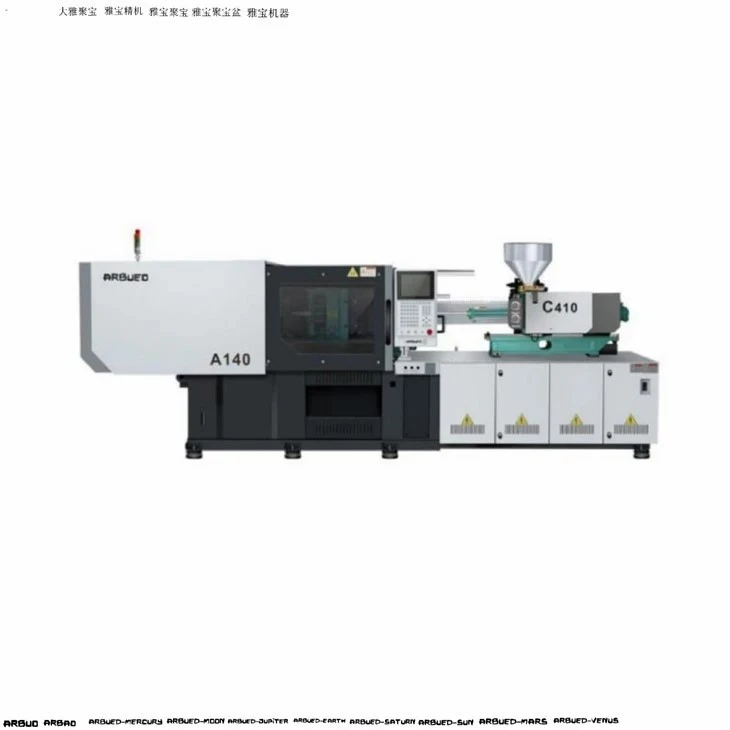
High-Speed Servo Injection Molding Machine
This hydraulic servo-driven injection molding machine is engineered for Tier 1 and Tier 2 automotive component manufacturers requiring strict dimensional tolerances, low optical distortion, and repeatable part weight control. Operating within clamping forces from 100 to 2,000 metric tons, the system processes technical thermoplastics (PA66-GF30, PBT, PC/ABS, PMMA, POM) for functional under-the-hood elements, interior trim, exterior lighting lenses, and structural components.
By integrating direct-drive servo-hydraulic power units, linear guide rails on the moving platen, and low-friction plasticizing screws, this machine achieves a shot weight repeatability tolerance within +/-0.15%. The closed-loop controller regulates injection pressure and screw position in 1-millisecond sampling intervals, eliminating flash and sink marks on multi-cavity automotive molds.
Key Specifications
The specifications below reflect standard operational parameters across representative tonnage classes.
|
Parameter |
Unit |
250-Ton Class |
500-Ton Class |
1,000-Ton Class |
|
Clamping Force |
kN |
2,500 |
5,000 |
10,000 |
|
Tie-Bar Distance (H x V) |
mm |
580 x 580 |
820 x 820 |
1,160 x 1,160 |
|
Max. Daylight |
mm |
1,080 |
1,480 |
2,050 |
|
Mold Thickness (Min-Max) |
mm |
200-600 |
300-800 |
450-1,100 |
|
Screw Diameter (B Screw) |
mm |
50 |
70 |
95 |
|
Injection Weight (PS) |
g |
440 |
1,220 |
3,150 |
|
Max. Injection Pressure |
bar |
2,050 |
1,920 |
1,780 |
|
Max. Injection Speed |
mm/s |
160 |
140 |
120 |
|
Ejector Stroke |
mm |
150 |
220 |
300 |
|
Hydraulic System Pressure |
MPa |
17.5 |
17.5 |
17.5 |
|
Pump Motor Power |
kW |
30 |
52 |
90 |
Key Features
Five-Point Double Toggle Clamping Mechanism: Heat-treated cast iron linkages feature self-lubricating graphite-impregnated bushings to prevent oil contamination inside the mold area.
Low-Friction Linear Guide Support: Moving platens rest on precision linear guide rails rather than tie-bars, reducing platen tilting under high mold weights and eliminating wear on tie-bar bushings.
Closed-Loop Servo-Hydraulic Drive: High-response servo motors paired with internal gear pumps regulate oil flow based on demand, cutting idle energy consumption by 40-60% compared to fixed-displacement pumps.
Multi-Stage Injection and Holding Pressure Controller: 10-stage injection velocity and 10-stage pressure holding curves prevent stress concentration around gate areas in thick-walled optical lenses.
Bi-Metallic Barrel and Screw Assembly: Sintered tungsten carbide barrel lining combined with continuous plasma-transferred arc (PTA) flight welding on the screw handles abrasive glass-fiber-reinforced polymers.
Multi-Core Pulling Control: Integrated dual-zone hydraulic core pullers allow complex slide sequences for automotive connectors and HVAC housings.
Working Principle / Machine Configuration
Clamping & Mold Setup: The moving platen advances via linear bearings. The five-point toggle locks, generating full clamping tonnage measured directly via tie-bar strain gauges.
Plasticizing: The bi-metallic screw rotates driven by a high-torque hydraulic motor. Temperature sensors along four heating zones regulate melt temperature within +/-1.0 deg C.
Injection Phase: A digital linear transducer measures injection position at 0.01 mm resolution. The servo pump adjusts hydraulic pressure up to 2,050 bar to fill the mold cavity.
V/P Switchover & Pack/Hold: The system switches from velocity to pressure control based on cavity position, hydraulic pressure thresholds, or external transducer signals.
Cooling & Ejection: While the melt cools, the screw rotates to plasticize material for the next cycle. The clamping unit retracts, and dynamic hydraulic ejectors remove the finished part.
Product-Specific Technical Advantages
Platen Deflection Mitigation
Conventional platens bow under full clamping pressure, causing flash at the mold center and tight wall tolerances at the edges. This platen design utilizes finite element analysis (FEA) optimization to distribute clamping force evenly across the mold mounting face, keeping parallelism under load within 0.05 mm across a 1,000 mm span.
Injection Response Time
The servo-hydraulic response time from standstill to maximum flow takes less than 35 milliseconds. Rapid acceleration prevents cold slugs and flow marks in long flow-length parts such as door panels and bumper brackets.
Temperature Stability in Plasticizing Units
PID temperature control modules utilize solid-state relays across ceramic heating bands. Closed-loop temperature regulation prevents thermal degradation of heat-sensitive polymers like POM and flame-retardant ABS.
Typical Applications
Lighting Systems: Headlamp housings (PP-TD20), thick-walled LED light pipes (PMMA/PC), rear lamp bezels (ABS).
Interior Trim: Instrument panel brackets (PC/ABS), air vent louvers (POM), glove box assemblies (PP).
Under-the-Hood Components: Engine cover shrouds (PA66-GF30), brake fluid reservoirs (PP), intake manifold shells (PA6-GF30).
Electrical & Connectors: Multi-pin automotive wiring connectors (PBT-GF15), fuse box lids (PA6).
Material Compatibility
The table below outlines plasticizing parameters for common automotive resins using standard bi-metallic screw profiles:
|
Polymer Grade |
Filler/Additive |
Barrel Temp Range (deg C) |
Pre-Drying Specs |
Screw Configuration |
|
PA66 |
30% Glass Fiber |
270-295 |
80-90 deg C / 4 hrs (Dehumidifying) |
High-Wear Bi-Metallic, Check Ring |
|
PC / ABS |
Unfilled / FR |
240-270 |
100-110 deg C / 3-4 hrs |
Low-Shear Mixing Screw |
|
PMMA |
Optical Grade |
210-240 |
80-90 deg C / 4 hrs |
Surface-Polished Clear Screw |
|
PBT |
15-30% Glass Fiber |
240-265 |
120 deg C / 3 hrs |
Anti-Corrosive Tungsten Coated |
|
PP |
20% Talc Filled |
190-230 |
80 deg C / 2 hrs |
Standard Polyolefin Profile |
How to Select / Configuration Options
Screw Diameter Selection
A Screw: Smaller diameter for thermal-sensitive materials or small shot sizes (10-30% barrel capacity).
B Screw: Standard L/D ratio (20:1 or 22:1) for general-purpose automotive resins.
C Screw: Larger diameter for high-volume parts requiring maximum shot capacity (above 70% max shot weight).
Optional Packages
Accumulator-Assisted High-Speed Injection Unit: Increases injection speeds up to 400 mm/s for thin-walled connectors and light guides.
Sequential Hydraulic Core Pulling: Upgradeable from 2 to 6 independent core loops with pressure adjustment valves.
Glass-Fiber Wear Protection Package: Sintered Xaloy barrel lining and hardened flight coatings for resins containing >30% glass or mineral content.
Hot Runner Interface Expansion: Integrated 8 to 32 zone hot runner temperature controllers built directly into the main machine cabinet.
Manufacturing & Quality Control
Every machine undergoes structured testing protocols prior to dispatch:
Structural Stress Relief: Cast platen frames undergo thermal annealing and shot blasting to relieve internal stress before CNC machining.
Platen Parallelism Testing: Laser alignment tools verify platen parallelism during dry-cycling across full daylight travel.
72-Hour Continuous Dry-Cycle Run: Machine operates at maximum toggle speed for 72 hours to verify hydraulic seal integrity, oil temperature equilibrium, and sensor stability.
Dynamic Injection Precision Test: Shot weight variation is measured across 100 consecutive dry-injection cycles using Polypropylene and ABS test molds.
Safety Compliance: Built in accordance with CE mark standards (EN 201 safety regulations for plastics and rubber machinery), featuring dual electrical/hydraulic interlocks on operator gates.
Customization & OEM Support
Automation Integration: EUROMAP 63 and EUROMAP 73 robot interfaces allow plug-and-play setup with top-entry or side-entry servo robots.
Custom Screw Geometry: Mixing head options (Maddock mixing elements or pin-type mixers) tailored for masterbatch dispersion and recycled content blending.
Volts and Frequency Adaptation: Electrical cabinets built to regional standards (e.g., 480V/60Hz for North America; 400V/50Hz for Europe; UL/CSA-compliant control panels on request).
What Buyers Should Provide for a Quote
To receive an accurate technical proposal and machine sizing analysis, submit the following technical details:
Part Drawings: 2D/3D CAD files (STEP, IGES) with critical dimensions and wall thickness values.
Material Specifications: Resin brand, grade, and percentage of fillers (e.g., Glass Fiber, Mineral, Flame Retardants).
Mold Details: Mold dimensions (Length x Width x Height), total weight, number of cavities, and hot runner requirements.
Target Cycle Time: Required output rate per hour or target cycle time per part.
Auxiliary Requirements: Need for integrated core pulls, valve gate controllers, or robot interfaces.
Submit Technical Data for Custom Proposal
Send your CAD files and mold specifications directly to our engineering team to receive a preliminary clamping force calculation and tailored machine configuration within 24 hours.
fAQ
Q: What level of shot weight consistency does this machine deliver?
A: Shot weight repeatability remains within +/-0.15% under stable ambient conditions when using high-resolution linear transducers and closed-loop hydraulic valve control.
Q: Can this machine run abrasive materials like 40% glass-fiber-reinforced Nylon?
A: Yes. Machines configured with our optional glass-fiber wear package feature a fully sintered bi-metallic barrel and a PTA carbide-clad screw, extending operational life under high-wear conditions.
Q: What interfaces are available for robotic automation?
A: Machines include EUROMAP 67 standard interfaces for robot signals. EUROMAP 73 and customized industrial Ethernet interfaces (Profinet, EtherCAT) are available upon request.
Q: How is hydraulic oil temperature managed during continuous operation?
A: The machine features a shell-and-tube or air-cooled oil heat exchanger paired with closed-loop oil temperature monitoring, maintaining hydraulic oil temperature within 40-50 deg C during 24/7 production.
Q: What warranty and spare parts support are provided to international buyers?
A: All standard machines include a 12-month complete system warranty and a 24-month structural warranty on platens and tie-bars. Critical spare parts (valves, heaters, thermocouples, seals) ship within 48 hours via global express logistics.
Hot Tags: high precision injection molding machine for automotive parts, China high precision injection molding machine for automotive parts manufacturers, suppliers, factory


