


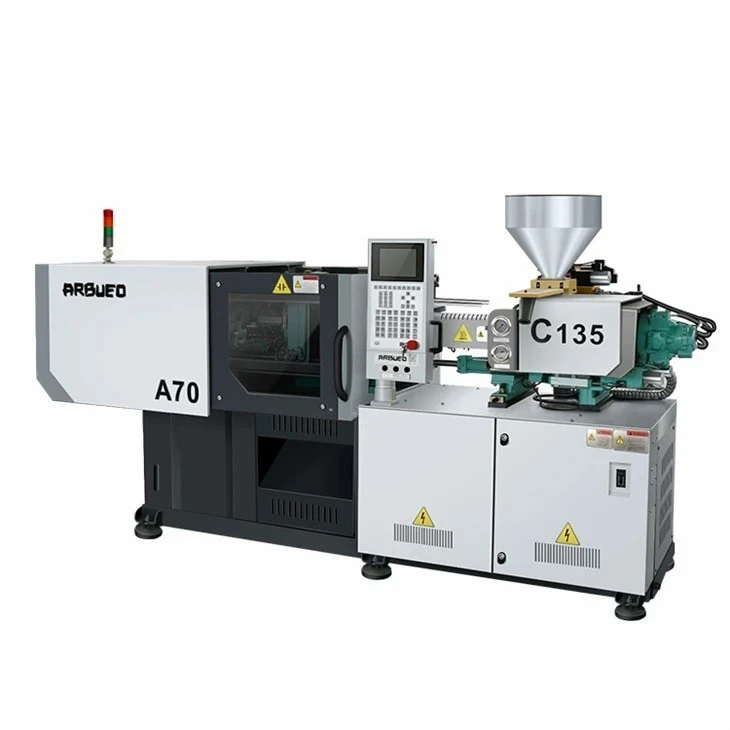
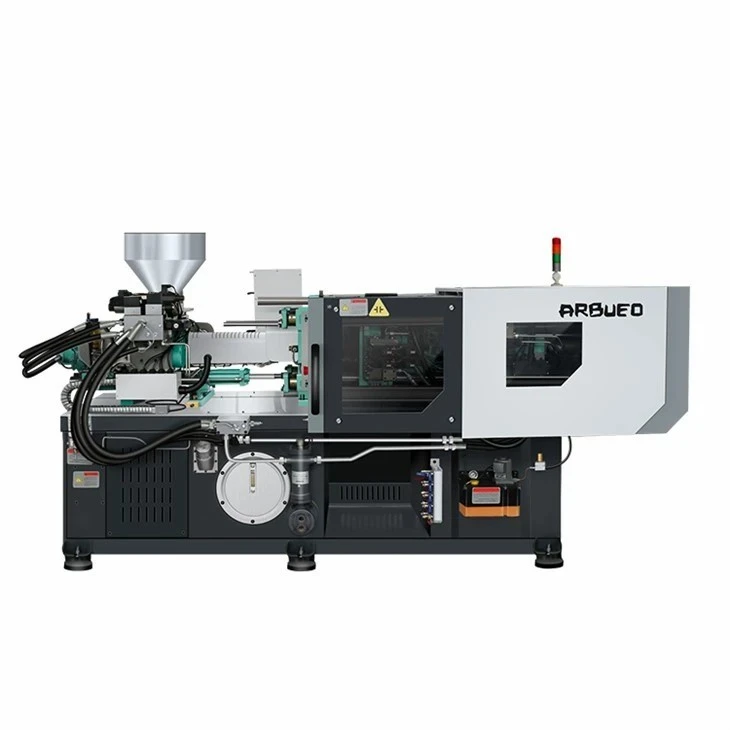
Precision Plastic Injection Molding Machine
Precision plastic injection molding machines deliver dimensional repeatability, low-shot weight variation, and fast cycle times for demanding industrial components. Built with high-rigidity platen structures, servo-electric/hydraulic hybrid drive systems, and closed-loop motion control, these units achieve repeat positioning accuracy down to +/-0.01 mm. Standard clamping forces range from 60 to 1,200 metric tons, supporting shot weights from 15 g to 4,500 g. The series handles engineering resins-including PEEK, LCP, PPS, PC, and PMMA-maintaining melt temperature stability within +/-0.5 deg C to minimize thermal degradation and shot-to-shot deviation.
Key Specifications
|
Parameter |
Specification Range / Value |
Test / Reference Condition |
|
Clamping Force |
600 kN - 12,000 kN (60 T - 1,200 T) |
ISO 20457 Compliance |
|
Tie-Bar Clearance (H x V) |
310 x 310 mm to 1,300 x 1,150 mm |
Standard Platen Layout |
|
Injection Weight (PS) |
15 g - 4,500 g |
Theoretical max calculated at 1.05 g/cm3 |
|
Injection Speed |
Up to 350 mm/s (Standard Servo) / Up to 800 mm/s (Accumulator-Assisted) |
Linear Encoder Feedback |
|
Screw Diameter Options |
22 mm - 110 mm |
L/D Ratio: 20:1 to 24:1 |
|
Injection Pressure |
1,400 bar - 2,400 bar |
Hydraulic / Servo-electric Pressure Sensor |
|
Platen Parallelism |
<= 0.05 mm under maximum clamping load |
Laser Dial Indicator Measurement |
|
Temperature Control Zones |
4 to 8 Barrel Zones + Nozzle |
PID Control, +/-0.5 deg C Precision |
|
Dry Cycle Time |
1.2 s - 3.8 s (depending on frame size) |
Euromap 6 Standard |
Key Features
Rigid Toggle-Clamping Kinematics: Finite Element Analysis (FEA) optimized platen design minimizes platen deflection under maximum clamping force, protecting mold surfaces and preventing flash.
Variable-Displacement Servo Drive System: High-response permanent magnet AC servo motors combined with internal gear pumps cut energy consumption by 30% to 70% compared to fixed-displacement systems.
Closed-Loop Injection Control: High-frequency response directional valves and real-time linear encoder feedback maintain stable injection speed profiles and V/P (Velocity-to-Pressure) switchover accuracy.
Bimetallic Barrel and Screw Assembly: Wear- and corrosion-resistant alloys prolong component life when processing up to 50% glass-fiber reinforced resins or fluoropolymers.
Industrial CNC Controller: Features a 15-to-19-inch touchscreen, storing up to 500 mold parameter sets, with integrated OPC-UA / Euromap 63 & 77 communication protocols for Industry 4.0 integration.
Working Principle / Machine Configuration
The machine operates on a sequential four-stage process: Plasticizing, Injection, Holding/Cooling, and Ejection.
Clamping Unit: A five-point twin-toggle mechanism generates uniform clamping force across the platen face. Automatic lubrication systems supply grease to toggle joints based on cycle counts.
Injection Unit: Dual injection cylinders balance axial thrust on the screw during high-speed injection. A linear potentiometer monitors screw displacement with 0.01 mm resolution.
Hydraulic / Electric Drive Matrix: High-pressure oil circuits use proportional valves for smooth acceleration and deceleration, preventing hydraulic shock and extending hose life.
Control Architecture: Real-time Linux-based controller manages loop update rates under 1 ms, executing precise melt-cushion monitoring to ensure constant cavity packing.
Product-Specific Technical Advantages
Melt Cushion Consistency Within +/-0.2 mm: Non-return valve geometry and fast-response check rings prevent resin backflow during the transition from injection to hold pressure.
Reduced Mold Wear: Platen parallelism controlled within 0.05 mm ensures even clamping pressure distribution across cavity parting lines, extending mold service life by over 30%.
Low Noise Operation: Operating noise levels remain below 75 dB(A) due to low-noise pump configurations and acoustic dampening frame mountings.
Fast Hydraulic Response: Hydraulic pressure build-up times remain under 30 ms from command signal to full pressure output, enabling tight control over thin-wall molding applications.
Typical Applications
Automotive Components
Produces engine bay connectors, sensor housings, interior trim clips, and fluid reservoir caps. Meets strict automotive tolerance standards (VDA 6.3 compliant process stability) for tight-fitting assembly parts.
Medical Devices & Syringes
Molds Luer-lock connectors, inhaler components, blood collection tubes, and diagnostic cartridges. Configured with oil-free tie-bars and cleanroom-compatible paint finishes to meet ISO Class 7/8 cleanroom standards.
3C Electronics & Connectors
Processes micro-connectors, smartphone internal frames, and laptop housing components requiring wall thicknesses down to 0.3 mm without short shots or sink marks.
High-Precision Industrial Valves & Gears
Produces small-pitch plastic gears, pump impellers, and threaded pipe fittings requiring low warpage and minimal runout tolerances (DIN 3967 Grade 8 or better).
Material Compatibility
|
Resin Type |
Typical Shrinkage Range |
Processing Temp Range |
Machine Requirement Notes |
|
ABS / PC+ABS |
0.4% - 0.7% |
220 deg C - 270 deg C |
Standard bimetallic screw; precise barrel temp control |
|
PA66 / PA6 (30% GF) |
0.3% - 0.8% |
260 deg C - 310 deg C |
Wear-resistant high-chrome screw flight coating |
|
PC / PMMA |
0.5% - 0.7% |
270 deg C - 320 deg C |
High injection pressure; precise tie-bar load balancing |
|
PEEK / PPS |
0.2% - 1.2% |
340 deg C - 400 deg C |
Ceramic heater bands; high-temperature barrel insulation |
|
POM |
1.8% - 2.5% |
190 deg C - 210 deg C |
Precise melt residence time control to prevent degradation |
How to Select / Configuration Options
Determining Required Clamping Force
Calculate required clamping force using cavity projected area (A, in cm2) and average cavity pressure (P_avg, in bar):
Clamping Force (Tons) = [ Projected Area (cm2) x Average Pressure (bar) x 1.2 Safety Factor ] / 1000
Thin-wall packaging: 0.6 - 1.0 Ton/cm2
Engineering technical parts: 0.4 - 0.6 Ton/cm2
Standard structural parts: 0.3 - 0.4 Ton/cm2
Choosing Screw Diameter & Geometry
Standard A Screw: Universal profile for unfilled commodity plastics (PP, PE, PS).
B Screw (High Pressure): Reduced diameter for engineering resins requiring high injection pressure (PC, PEEK).
C Screw (High Mixing): Expanded L/D ratio with mixing elements for masterbatch dispersion and optical grade clarity.
Optional Machine Modules
Accumulator Injection Package: Boosts injection speeds up to 800 mm/s for thin-wall applications.
Core Pull Circuits: Hydraulic or electric control blocks for complex mold slide actions (1 to 4 circuits).
Tie-Bar Pulling Device: Allows mold installation in facilities with low overhead crane clearances.
Insulated Barrel Cover: Cuts barrel thermal radiation losses by up to 25%.
Manufacturing & Quality Control
Every machine undergoes systematic dynamic and static testing prior to factory acceptance testing (FAT) according to the following quality assurance sequence:
Manufacturing & Testing Sequence
Raw Frame Welding: Structural assembly and heavy-gauge steel welding of the machine base.
Vibrational Stress Relief: Mechanical stress relief applied to the welded frame to eliminate internal material tension before precision machining.
5-Axis CNC Milling: Single-setup machining of platen mounting surfaces and tie-bar guide locations.
Platen Assembly: Precise alignment and mechanical mounting of stationary and moving platens onto the machine bed.
Laser Interferometer Alignment: Optical verification and calibration of platen squareness and tie-bar parallelism.
Hydraulic & Electrical Wiring: Installation of proportional valve manifold blocks, high-pressure oil lines, servo drives, and control cabinets.
100-Hour Continuous Dry-Run Test: Extended cycle testing to verify system integrity, thermal stability, and hydraulic seal reliability.
Full Load Injection & Pressure Hold Verification: Final dynamic testing under 100% clamping tonnage and maximum hydraulic injection pressures.
Core Quality Assurance Protocols
Platen Machining: Platen surfaces are milled in a single setup on 5-axis gantry CNC machining centers to maintain strict perpendicularity between tie-bar holes and platen faces.
Stress Relieving: Welded machine bases undergo thermal or vibrational stress relief to prevent frame distortion over extended operating periods.
Laser Alignment: Tie-bar parallelism and platen movement accuracy are measured using Renishaw laser interferometers to ensure exact alignment under load.
100-Hour Dry Run: Machines complete 100 continuous hours of dry-cycling to verify thermal equilibrium, hydraulic oil stability, and zero leak integrity at operating pressures up to 210 bar.
Customization & OEM Support
Specialized Screw & Barrel Metallurgy: Choice of fully hardened powder metallurgy steels (CPM-10V, CPM-9V) for processing corrosive materials (fluoropolymers) or high-abrasion resins (up to 60% glass fiber/mineral fill).
Cleanroom Execution: White polyurethane paint finish, stainless steel platen covers, non-corroding tie-bar platings, and food-grade synthetic lubricants.
Automation Interfaces: Factory-installed Euromap 67 or Euromap 73 interfaces for robot pick-and-place systems, conveyor integration, and automated mold clamping circuits.
Multi-Component Expansion: Modular addition of secondary injection units (piggyback, L-shape, or vertical layout) for two-color / multi-material molding.
What Buyers Should Provide for a Quote
To receive an accurate technical quotation and machine sizing evaluation, supply the following parameters:
Part Information:
3D CAD files (.STEP / .IGS) or 2D drawings showing dimensions and wall thickness.
Part weight (grams) and projected surface area (cm2).
Resin Specifications:
Specific polymer grade, manufacturer, and fill percentage (e.g., PA66 + 30% GF).
Mold Details:
Mold dimensions (L x W x H), total cavity count, and stack height.
Runner type (Hot runner system vs. Cold runner).
Core pull requirement (number of hydraulic/electric core sequences).
Production Targets:
Target cycle time (seconds).
Daily/monthly volume targets.
Regional Specifications:
Operating voltage and frequency (e.g., 400V 50Hz / 480V 60Hz).
Local safety compliance requirements (CE, UL, ANSI/SPI B151.1).
FAQ
Q: How is platen parallelism verified on these machines?
A: Platen parallelism is verified under 100% clamping load using dial indicators mounted on the tie-bars. Maximum permissible deviation is set to <= 0.05 mm across the entire platen area, meeting ISO 20457 tolerances.
Q: What is the average energy consumption per kilogram of processed material?
A: With the standard servo-electric hybrid hydraulic drive, power consumption averages between 0.30 kWh/kg and 0.45 kWh/kg for standard PP/PE resins, depending on cycle time and cooling parameters.
Q: What interfaces are provided for automated part removal?
A: Machines include standard Euromap 67 (16-pin) or Euromap 73 robot interfaces. Signals cover ejector position, safety gate interlocks, mold open position, and robot access permissions.
Q: Can these machines process high-temperature thermoplastics like PEEK or PEI?
A: Yes. High-temperature configurations include specialized ceramic heating bands capable of reaching 450 deg C, insulated barrel jackets, water-cooled feed throats, and wear-resistant bimetallic screw assemblies designed for high melt viscosity.
Q: How does the closed-loop control system maintain shot weight repeatability?
A: The injection unit uses a linear position encoder with 0.01 mm resolution paired with a dynamic pressure transducer. The controller updates drive output at sub-millisecond intervals to adjust the V/P switchover point and hold pressure profile based on real-time melt resistance.
Hot Tags: precision plastic injection molding machine, China precision plastic injection molding machine manufacturers, suppliers, factory


